
Wild markets. Calm trader.
Your trading strategy, automated.
Wildflower is automation machinery for futures traders. You create your strategy. Wildflower runs it, on your machine, under your own broker account. Aka a build-your-own bot, where you have full control.
Trading futures carries risk. You can lose money.
What it is
You write the rules. Wildflower keeps them.
Wildflower is the part between a strategy and an order. It reads what you wrote, watches the market on your own feed, and acts when your conditions are met.
The strategy is yours
Entry conditions, stops, targets, sizing, sessions, all of it. Wildflower ships no strategies and no starting values on anything that affects a trade. Those fields arrive empty and stay empty until you fill them.
The rules run the same way every time
The engine reads your rules and acts on them. Same inputs, same decision, at 9am and at 3pm, on a quiet day and a loud one.
It runs where you are
The engine, your broker session and your market data sit on your own computer. The app on your phone shows you what happened.
How it works
Author, test, run. One engine for all three.
The code that runs your strategy live is the code that ran your backtest. There is no second implementation to drift away from the first.
Author it
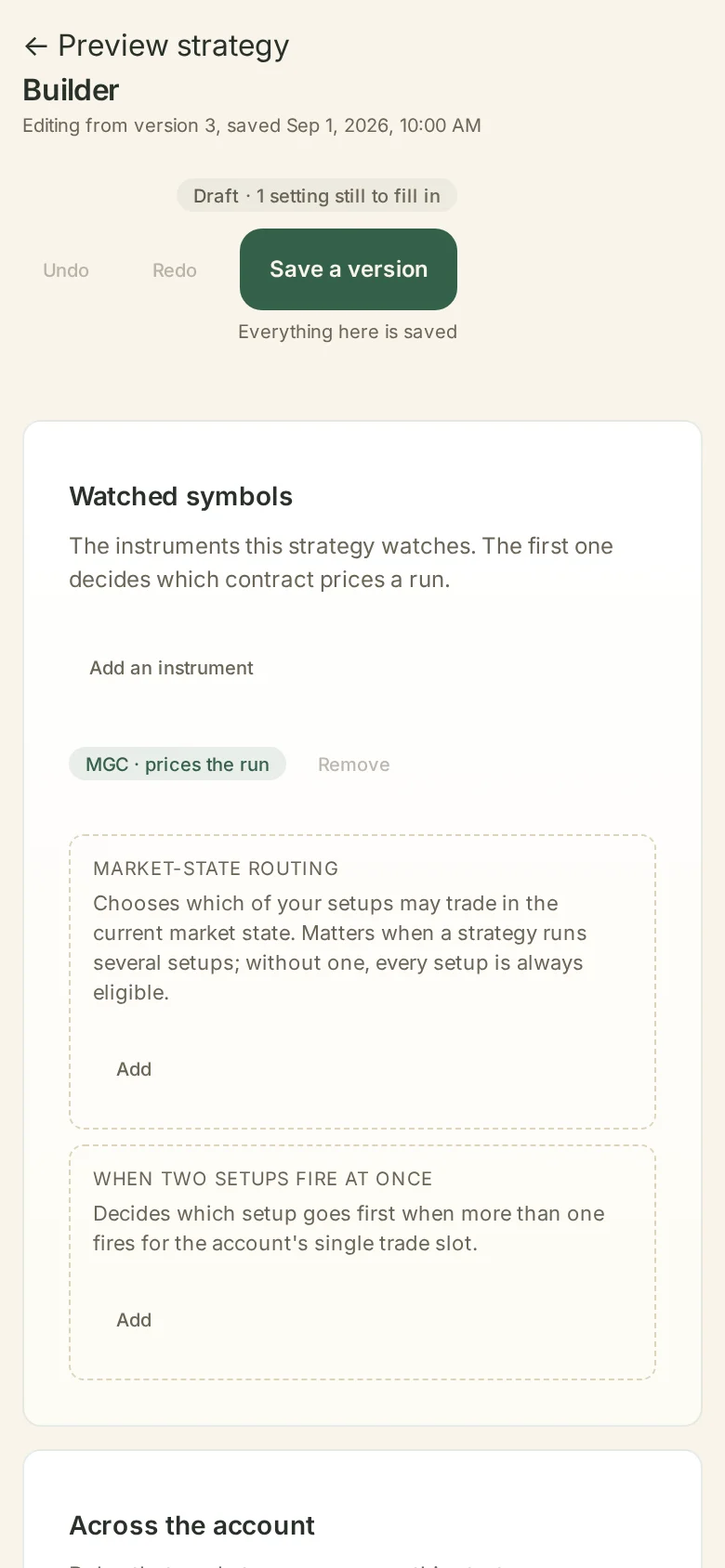
Build the strategy from blocks on a chart, or describe it in your own words and have it transcribed into blocks. Every trading parameter is typed by you or confirmed by you.
Test it
Run it over history before it runs on anything else. Every result carries the fill assumptions it was produced under.
Run it
Connect a strategy to one of your accounts and arm it. It places and manages orders through your broker session, and tells you what it did.
The check on our own work
Every live session is re-run and compared.
Every live session is re-run independently as a backtest over the same data. You see the agreement.
- The backtest uses the same strategy version, the same recorded data and the same engine build.
- The two decision streams are compared decision by decision.
- Each difference is listed with its timestamp, the input that differed, and what each pass did next.
- The agreement figure measures the machinery. It says nothing about whether a strategy makes money.
What is checked
After every live session, Wildflower replays your strategy over the same bars and checks the trades it took against the trades your strategy called for: same entry, same stop, same target. Any difference is shown to you.
Safety
Your risk rules, executed as standing instructions.
You set the condition. Wildflower acts when the condition is met, because you told it to. It does not choose these numbers and it does not suggest them.
Close what is open
Name the condition under which every position on an account closes. When it is met, Wildflower closes them and stops.
Stop everything
One control closes every open position and stops new trades on every connected account, until you clear it.
Lockouts
A daily loss figure, a daily profit figure, a run of losing trades. When the limit you entered is reached, no new trades are taken for the rest of the trading day.
Alert first
Every rule starts as an alert, and stays one until you say otherwise. Stopping new trades, or closing what is open, is chosen rule by rule — and the one that can close a position asks you to confirm before it is armed.
Wildflower never places a trade by hand on your behalf. Not once, not for anyone, not in a support call.
Nothing here is in a hurry.
Wildflower is software you rent by the month or the year. Trying it on the practice chart is free, and you can stop at the end of any period you have paid for.
Trading futures carries risk. You can lose money.