
How futures contracts work: a plain-English guide
By Bec, futures trader and founder of Wildflower · Updated
A futures contract is an agreement, made on an exchange, to buy or sell a set amount of something at a price agreed now, for a date in the future. Each contract has a fixed dollar value for every point price moves, so a trade’s profit or loss is the points moved times that value times the number of contracts. Many traders close their trade before the contract ends and never deliver or receive anything.
What a futures contract is
A An agreement, traded on an exchange, to buy or sell a set amount of something at a price agreed now, on a set date later.More in the glossary is a promise between a buyer and a seller: one will buy, the other will sell, a set amount of something at today’s agreed price, on a set date. It started with farmers and grain buyers fixing a price before the harvest. Today there are futures on stock indexes, oil, gold, currencies, interest rates and bitcoin.
Every contract of one kind is identical: the same amount, the same date, the same rules. That’s what makes them easy to trade. You don’t pick who you trade with. A clearing house stands between every buyer and seller, so neither side has to trust the other.
Many traders never hold a contract to its end. They buy and later sell (or sell and later buy back) and keep the difference, which can be a gain or a loss. The price moves because the market’s view of that future price changes all day.
What’s in a futures contract
Each contract has a page of specifications from its exchange. These are the parts that matter most when you trade:
- What it’s based on. The S&P 500 stock index, a barrel of oil, an ounce of gold.
- The The dollars one point of price is worth on one futures contract. On the E-mini S&P 500 it’s $50, and on the Micro E-mini $5.More in the glossary. The dollars one point of price is worth on one contract. On the E-mini S&P 500 (symbol ES) it’s $50. On the Micro E-mini S&P 500 (MES) it’s $5.
- The The smallest step a price can move. On many stock index futures that’s 0.25 of a point.More in the glossary. The smallest step price can move. On ES and MES it’s 0.25 of a point, worth $12.50 on ES and $1.25 on MES.
- Contract months. Which months have a contract. ES and MES have four a year: March, June, September and December.
- Expiry and settlement. When the contract ends, and how. ES and MES end on the third Friday of their month and settle in cash.
- Trading hours. CME’s stock index futures trade from Sunday evening to Friday afternoon, with a one-hour break each day.
So on MES, one tick is $1.25 and one point (four ticks) is $5. A symbol like ESZ6 puts it together: ES, then Z for December, then 6 for 2026. Read about ticks and tick value.
How a futures trade makes or loses money, step by step
1. Buy one contract
You buy 1 MES at 6,000. You don’t pay its full value. You keep margin instead (more below).
2. Price moves
Price rises to 6,008. That’s 8 points.
3. Count in ticks
8 points is 32 ticks of 0.25.
4. Close the trade
Sell at 6,008. 32 ticks × $1.25, or 8 points × $5, is $40.
The sum is always the same: points moved × dollars per point × number of contracts. Two contracts would be $80. If price had fallen 8 points instead, the same sum gives −$40. Fees come off on top, charged per contract. Read about order types.
Going long and going short
Long means you bought first. You gain if price rises and lose if it falls.
Short means you sold first, and you close by buying back. You gain if price falls and lose if it rises. With futures, selling first is as simple as buying first. You don’t borrow anything, because you’re taking the other side of the same agreement.
Micro and E-mini contracts
The same market often has more than one contract size. The chart is the same and the price is the same. Only the dollars per point change. A 12-point move is $600 on one ES and $60 on one MES, whether it’s a gain or a loss.
- S&P 500: ES is $50 a point, MES is $5.
- Nasdaq-100: NQ is $20 a point, MNQ is $2.
- Gold: GC is $100 for each $1 move in gold’s price, MGC is $10.
These three micros are a tenth of the bigger contract, but not every micro is. Micro Bitcoin futures are a fiftieth of the full size. Check each contract’s own specifications.
Expiry, month codes and rollover
Every contract has an The day a futures contract stops trading and is settled, in cash or by delivery.More in the glossary: the day it stops trading. The contract with the nearest expiry is called the front month, and it’s usually the one with the most trading. Each month has a one-letter code:
- F January, G February, H March, J April, K May, M June
- N July, Q August, U September, V October, X November, Z December
So ESH7 is the E-mini S&P 500 for March 2027. Before a contract expires, trading moves to the next one. Moving your trading, or an open position, from one month to the next is called Moving from a futures contract that’s about to expire to the next contract month.More in the glossary, or the roll. For stock index futures, most trading moves across several days before expiry.
Two contract months trade at different prices. In this made-up example, December is 40 points above September on the day of the roll. A chart that joins them, often called a continuous chart, has to deal with that gap. Left alone, it shows a jump no one traded. Back-adjusted, the older prices are shifted to line up, so they’re no longer prices that really traded. Both matter when you look back at old charts.
Some contracts, like ES and MES, settle in cash at expiry. Others, like crude oil and gold, can end in delivery of the real thing. Brokers usually close or block positions in those before delivery, but the rules are the broker’s.
Margin and daily settlement
A contract’s full value is its price times its multiplier. At a made-up price of 6,000, one ES stands for $300,000 of the index, and one MES for $30,000. That’s called the notional value. You don’t pay it.
Instead, you keep Money kept in a futures account as a deposit to cover losses on open contracts. It isn’t a fee or a down payment, and losses can be bigger than it.More in the glossary in your account: a deposit that shows you can cover losses. It isn’t a fee and it isn’t a down payment. The exchange sets a minimum, and your broker can ask for more. Brokers often set a lower amount for trades opened and closed in the same day. Those amounts change over time.
Futures are settled every day. At the end of each day, the exchange sets a settlement price, and gains and losses since the day before are paid into or out of accounts in cash. In the picture, one MES held for three days gains $50, loses $100, then gains $50.
Because the margin is a small part of the notional value, a small move in price is a big change compared with your deposit. People call this leverage. It makes gains and losses both larger compared with the money in the account, and a loss can be bigger than the margin. Read about margin and leverage.
Often confused with
Stocks. A share is part-ownership of a company, and you can hold it for as long as you like. A futures contract is an agreement with an end date, and you own nothing but the agreement.
Options. An option gives the right, but not the duty, to buy or sell. A futures contract binds both sides.
CFDs. A contract for difference is an agreement with a broker, not traded on an exchange, and it usually has no expiry. CFDs aren’t allowed for retail traders in the United States.
Forwards. A private agreement between two parties, made to their own terms, not traded on an exchange.
Spot price. The price for buying the real thing today. A futures price can sit above or below it.
Testing a futures strategy in Wildflower
Every test trade counted in real contracts
When you backtest your own strategy in Wildflower, you choose the market, and every trade is sized in whole contracts of it, so each result uses that contract’s own dollars per point. You type your fee per contract, and each trade’s profit is shown before and after fees. If your chart file joins contract months at the roll, it tells you, because shifted prices can put a stop or target on a price that never traded.
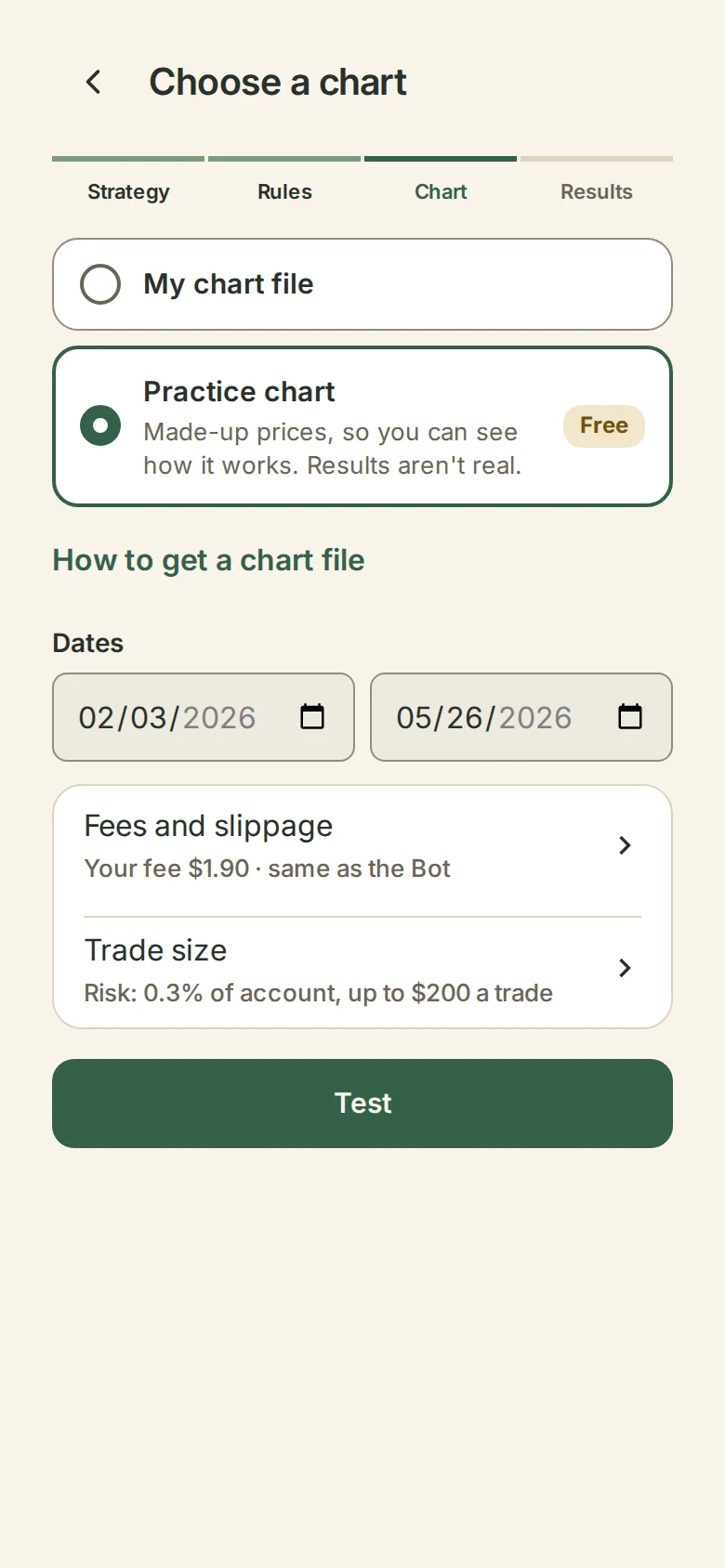
Set it up and see how it works, free. Only pay when you backtest on real market history.
Common questions
How do futures contracts work?
Two sides agree a price now for a set amount of something on a later date. Many traders close before that date and keep the difference, a gain or a loss.
How much is one point on ES and MES?
$50 on ES (E-mini S&P 500) and $5 on MES (Micro E-mini S&P 500).
What does the Z in ESZ6 mean?
Z is the code for December, so ESZ6 is the December 2026 E-mini S&P 500 contract.
When do ES futures expire?
On the third Friday of March, June, September and December.
What is rollover in futures?
Moving from a contract that’s about to expire to the next month’s contract. More above.
Do I have to take delivery of a futures contract?
Not with cash-settled contracts like ES and MES. Some others, like crude oil and gold, can end in delivery, and brokers usually close those positions before then.
Can you lose more than your margin on futures?
Yes. Margin is a deposit, not a limit on losses. A big move can take more than the margin in your account.
Can you short futures?
Yes. Selling first is as simple as buying first. You gain if price falls and lose if it rises.
What’s the difference between micro and mini futures?
Size. The chart is the same, but each point is worth less. MES is a tenth of ES.