
Position sizing in futures: how many contracts to trade
By Bec, futures trader and founder of Wildflower · Updated
Position sizing is working out how many contracts to trade. Start with the most you’re willing to lose if your An order that closes a trade if price reaches a level you set against it. It aims to limit the loss, but in a fast market it can fill at a worse price.More in the glossary is hit. Divide it by what one contract would lose at that stop (the ticks to the stop × the What one tick is worth in money for one futures contract. On the E-mini S&P 500 it’s $12.50.More in the glossary), and round down to a whole number.
What position sizing is
Your How many contracts, shares, lots or coins a trade uses.More in the glossary is how many An agreement, traded on an exchange, to buy or sell a set amount of something at a price agreed now, on a set date later.More in the glossary a trade uses. Position sizing is deciding that number before you place the trade.
It matters because every contract moves together. If one contract loses $100 when the stop is hit, three contracts lose $300. The stop sets where you get out. The size sets how much money that stop is worth.
Many traders start from the other end. They decide the most they’re willing to lose on one trade, then work out how many contracts fit. That amount is their The most money a trade is planned to lose if its stop loss is hit, before slippage and fees. Each trader chooses their own.More in the glossary. What it is, and how you choose it, is up to you. This page only shows the sum.
All the dollar amounts here are made up. The contract figures are real: on the E-mini S&P 500 (ES), one tick is 0.25 of a point and is worth $12.50 per contract. Read about ticks and tick value.
The position sizing formula for futures, step by step
Contracts = amount at risk ÷ (ticks to the stop × tick value), rounded down. Say you’ve picked $300 as the most to lose on this trade, and you’re buying ES at 5,000.00.
1. Mark the entry and the stop
In at 5,000.00, with a stop at 4,998.00.
2. Count the ticks to the stop
5,000.00 − 4,998.00 = 2 points. On ES that’s 2 ÷ 0.25 = 8 ticks.
3. Work out the risk per contract
8 ticks × $12.50 = $100. That’s what one contract loses at the stop.
4. Divide, and round down
$300 ÷ $100 = 3 contracts. If the stop is hit, 3 × $100 = $300.
The same sum works on any futures contract. Only the tick size and tick value change, and the exchange publishes both for every contract.
A wider stop means fewer contracts
Keep the amount at risk the same and move the stop. A stop 4 ticks away risks $50 a contract, so $300 fits 6 contracts. A stop 12 ticks away risks $150 a contract, so it fits 2.
Either way, hitting the stop loses $300. The size changes so the money at risk doesn’t. That’s the idea behind sizing from the stop: the stop is placed first, and the size follows it.
Minis and micros: sizing in smaller steps
The Micro E-mini S&P 500 (MES) is a A smaller version of a futures contract. It moves in the same steps as the full-size one, but each step is worth less, often a tenth as much.More in the glossary: it moves in the same 0.25 steps as ES, but each tick is worth $1.25, a tenth as much. The same 8-tick stop risks $10 per MES contract, so $300 fits 30 of them.
Ten MES contracts carry the same dollars per tick as one ES. So micros let you size in smaller steps. That matters most when the amount at risk is small, or the stop is far away.
Rounding, and what counts
Round down, not to the nearest. Contracts only come in whole numbers. With a stop 10 ticks away, $300 ÷ $125 = 2.4. Two contracts risk $250. Rounding up to 3 would risk $375, more than you set out to.
Sometimes nothing fits. With a stop 32 ticks away, one ES contract risks $400, more than $300 on its own. The answer is 0. Some traders skip the trade then. Some use a micro contract instead, where one contract risks a tenth as much. That’s a choice, not a rule.
Short trades work the same. For a sell, the stop sits above the entry. Count the ticks up to it instead of down.
The stop in the sum is the one that counts. If the stop moves after the trade is on, the money at risk moves with it.
What the sum leaves out
The amount at risk is a plan, not a promise. Four things can make the real result different:
- Slippage. A stop becomes a market order when it’s hit, and in a fast market it can fill past your price. That’s called The difference between the price you expected and the price your order filled at.More in the glossary. Here it filled 2 ticks past, so 3 contracts lost $375, not $300.
- Gaps. If the market reopens beyond your stop after a pause, the fill can be much further away.
- Fees. What your broker and the exchange charge for each contract you trade, often quoted per contract for the round trip: in and out.More in the glossary is charged per contract, so 30 micros cost more in fees than 3 minis for the same dollars per tick.
- Margin and account limits. Your broker needs enough Money kept in a futures account as a deposit to cover losses on open contracts. It isn’t a fee or a down payment, and losses can be bigger than it.More in the glossary for every contract, and a prop firm account may cap how many you can hold. Margin isn’t the same as what you can lose.
Some traders size on a stop a few ticks wider than the real one, so a little slippage still fits. That’s a personal choice too.
Other ways traders size a trade
Working back from the stop is one method. You’ll also see these:
- A fixed number of contracts. The same size on every trade. The money at risk then changes with every stop.
- A share of the account. The amount at risk is a percentage of the account balance, so it grows and shrinks with the account. The percentage is each trader’s own choice.
- A share of the room left. On prop firm accounts, some traders size from the distance between their balance and the account’s loss limit.
- Volatility-based sizing. The stop is set from how much the market has been moving, often with the average true range (ATR), and the size then follows the stop. Read about ATR.
None of these is right or wrong. They answer the same question in different ways: how much money is each trade allowed to put at risk?
Often confused with
Risk to reward. How far the target is compared with the stop. It doesn’t change with the size: 3 contracts or 30, the ratio is the same. Read about risk to reward.
Leverage and margin. Margin is the deposit your broker holds for each contract. It decides how many contracts your broker lets you hold. It doesn’t tell you what a trade loses at its stop. Read about margin and leverage.
Lot size. Forex traders size in lots instead of contracts, and a lot can be split into small steps. The sum is the same idea. Read about futures contracts.
Scaling plan. A prop firm rule on how many contracts an account may hold as its balance grows. It’s a ceiling set by the firm, not a way of sizing. Read about scaling plans.
Position sizing in a Wildflower backtest
See the size of every trade, worked out for you
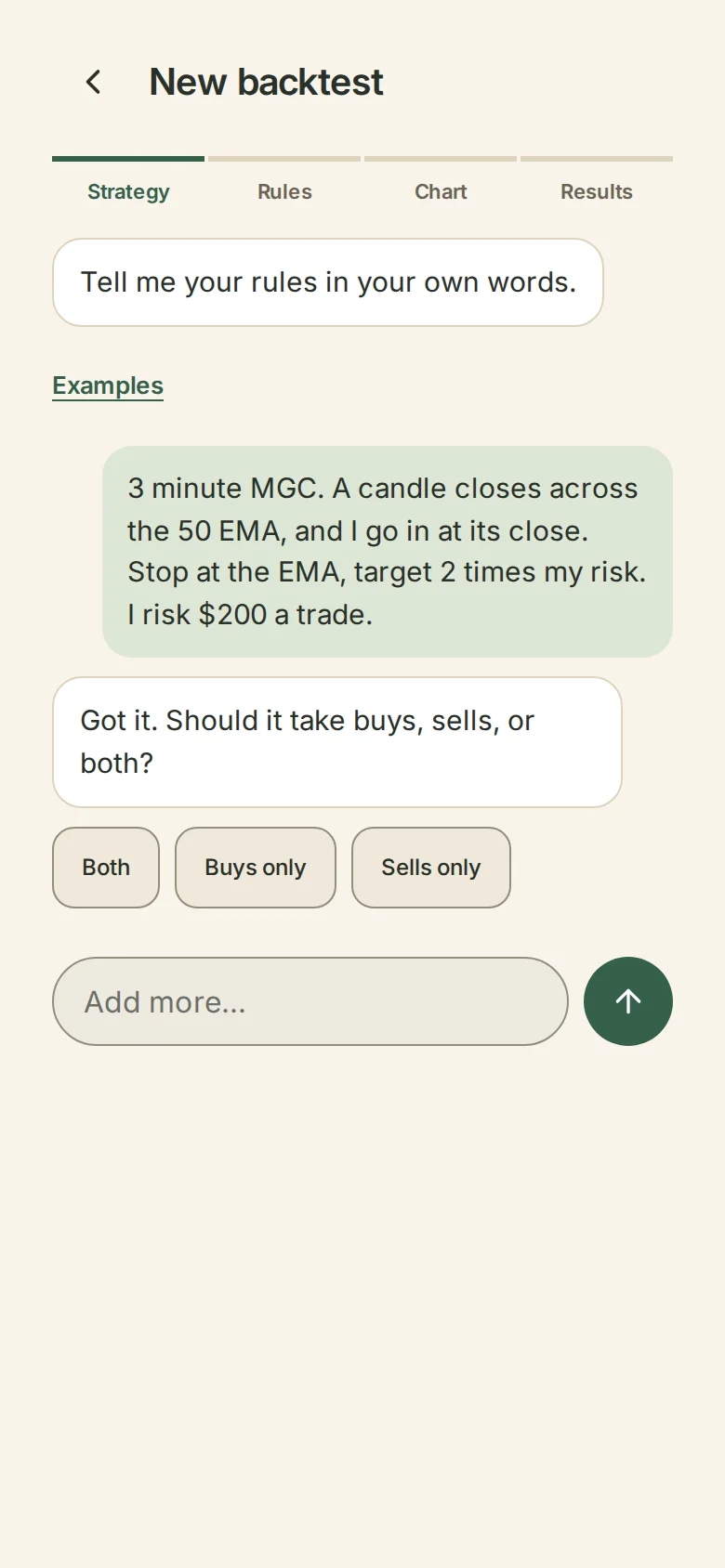
When you backtest a strategy in Wildflower, you choose one of four ways to size each trade: a dollar amount per trade, a number of contracts, a percentage of your account, or a percentage of the room left before your loss limit. You type every number, and every box starts empty. Your maximum dollar risk per trade applies on top: a trade that would risk more at its stop is sized down, and one that can’t fit a single contract isn’t taken. It’s the Bot’s own sizing, so each trade shows the contracts the Bot would use.
Free on a practice chart
Common questions
What is position sizing?
Working out how many contracts (or shares, or lots) to trade, so the money at risk matches what you planned.
How do I work out how many futures contracts to trade?
Divide the most you’re willing to lose by what one contract loses at your stop (ticks to the stop × tick value). Round down.
Why round down?
Rounding up puts more money at risk than you planned. Contracts only come in whole numbers.
What if the answer is less than one contract?
Then even one contract risks more than your amount. Some traders skip the trade, and some use a micro contract.
How much should I risk per trade?
That’s your decision, and Wildflower doesn’t suggest a number. This page shows how to turn whatever amount you choose into a number of contracts.
Does position size change the risk to reward ratio?
No. The ratio compares the distances to the target and the stop. Size changes the dollars on both sides equally.
Does position sizing protect me from bigger losses?
It limits the planned loss at the stop. Slippage, gaps and fees can still make a loss bigger.
Is margin the same as risk?
No. Margin is a deposit your broker holds. What you can lose depends on how far price moves against you and how many contracts you hold.
How do micro contracts help with sizing?
Each micro tick is worth a tenth of the full-size contract, so you can size in smaller steps.
Learn it step by step in Wildflower Trading School, starting with the lesson “Position sizing with ticks and tick values”.