
Forward testing a trading strategy: what it is, and how replay fits in
By Bec, futures trader and founder of Wildflower · Updated
Forward testing means running a finished strategy on new prices as they happen, without changing it, and recording every trade. A backtest runs on past prices. Replay sits in between: you step through past prices one candle at a time with the future hidden.
What forward testing is, and why it’s called that
A Running a strategy’s exact rules over past prices to see which trades they would have taken.More in the glossary looks back. It runs your rules over prices that have already happened. A Running a finished strategy, unchanged, on new prices as they arrive, and recording every trade.More in the glossary looks forward. You finish your rules, then run them on prices that don’t exist yet, as they arrive, and write down every trade.
Those new prices are History kept back while a strategy’s rules are built, then used once to test the finished rules unchanged. The part used to build them is in-sample.More in the glossary by nature. Nobody could have fitted the rules to them, because they hadn’t happened when the rules were written. That’s the main reason traders forward test.
You’ll also hear it called Following a strategy’s trades without real money, on a demo account or on paper, to see how it behaves.More in the glossary, demo trading or incubation. The ideas overlap. Paper trading and demo trading mean no real money is involved. Some traders forward test with a small real position instead.
How a forward test works, step by step
1. Fix the rules
Finish building and backtesting, then freeze the version. This made-up rule buys the next open after a close above the last 3 highs, with a 2-point stop and 3-point target.
2. Run it on new prices
Each new candle arrives and the rules decide, one candle at a time. Nothing about the rules changes.
3. Record every trade
Every trade goes in the record, the losing ones too. Here, three trades on 16 new candles.
4. Compare with a backtest
Backtest the same new dates and put the two side by side. Here, one entry filled a tick worse.
The comparison is the useful part. If the trades match the backtest of the same dates, apart from small differences in fills, the backtest is describing what the rules really do. If they don’t match, something differs between the two, and it’s worth finding what. Read why backtests and live results differ.
Replay: stepping through past prices candle by candle
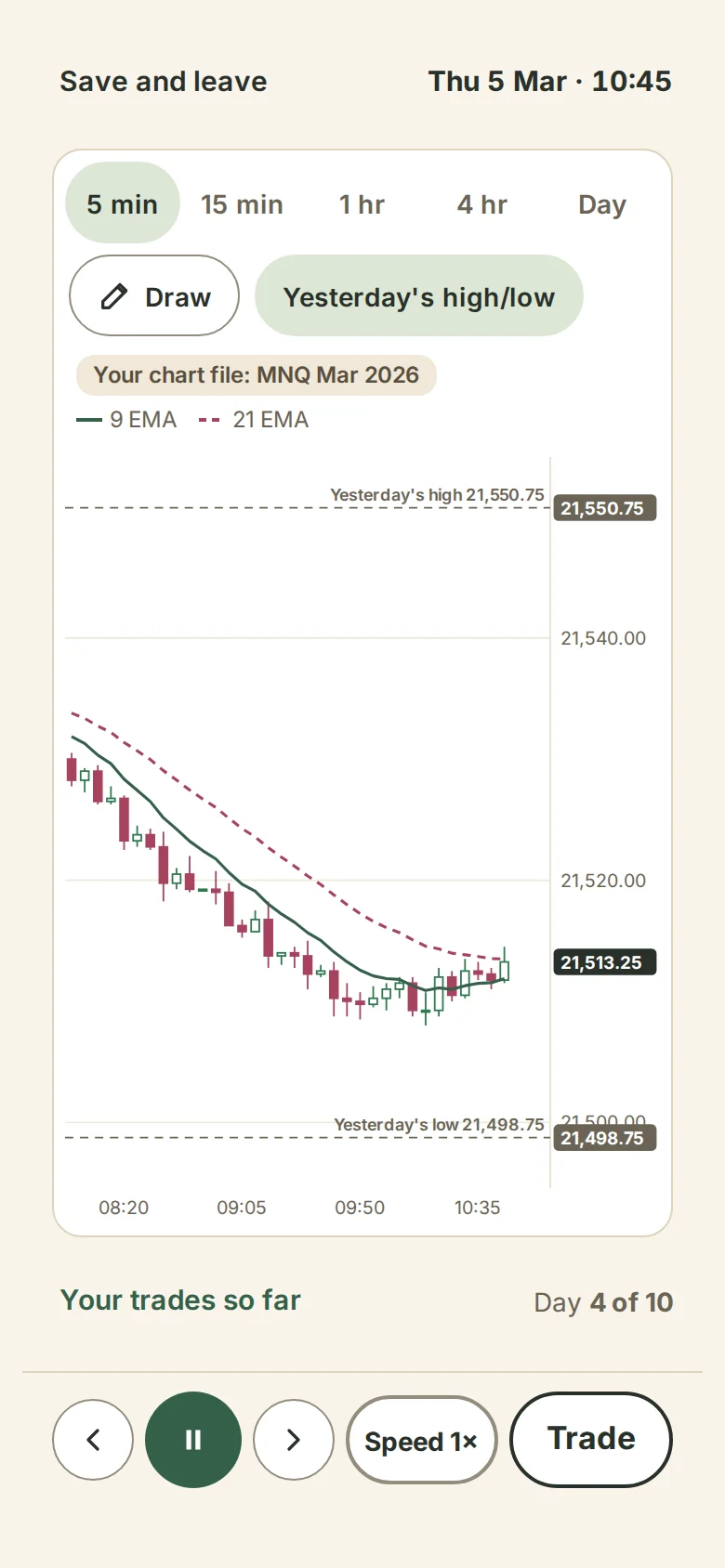
Replay (also called bar replay, or manual backtesting) plays past prices back one candle at a time, with every later candle hidden. You see a setup form, an entry, a stop and a target, in the order they happened. Many charting platforms have a replay mode.
Replay isn’t a forward test. The prices already exist, so a replay can cover a month in an afternoon. But because the future is hidden, it shows you what it was like to decide in the moment. Traders use it to check that rules do what they meant, to practise taking or skipping trades, and to test rules that still have some judgement in them.
The weak spot is memory. If you’ve seen those dates before, you may remember what happened next. That’s a kind of A backtest mistake: using a price the strategy couldn’t have known yet at the moment it made its decision.More in the glossary. Some replay tools can hide the dates for this reason.
What makes a fair forward test, and what doesn’t
- Freeze the rules first. If you change a rule partway through, the record mixes two strategies and describes neither.
- Record every trade. Leaving out the ones you’d rather forget, or restarting after a bad week, makes the record look better than it was.
- Keep the size the same. Changing how many contracts a trade takes changes the dollars, even when the rules’ decisions stay the same.
- Give it enough trades. A few weeks may hold only a handful of trades. How many is enough is your call. Read about sample size.
- Compare like with like. Backtest the exact dates the forward test covered, with the same fees and The difference between the price you expected and the price your order filled at.More in the glossary.
What a forward test can and can’t tell you
A forward test can show that your rules run the way you expect on prices nobody has seen, and that the trades match a backtest of the same dates. It can also catch practical problems a backtest can’t: a data feed that drops out, an order type your broker handles differently, or a person who skips trades.
It can’t tell you what the next month holds. It covers one stretch of the market, at the speed of the market, so a month of forward testing takes a month. A demo account’s fills are estimates too. Real fills, with real queues and real The difference between the price you expected and the price your order filled at.More in the glossary, only happen with real orders.
Forward testing, replay and backtesting answer different questions, so many traders use all three. Read about walk-forward testing, which repeats the out-of-sample check through past prices.
Often confused with
Walk-forward testing. Many build-and-test rounds on past prices, one window after another. It’s done on history, not on new prices. Read about walk-forward testing.
Out-of-sample testing. Testing on a stretch of past prices you kept aside. A forward test is out-of-sample too, but on prices that didn’t exist yet. Read about in-sample and out-of-sample.
Walking forward candle by candle. Every backtest steps through the candles one at a time, so it only sees what had closed. That’s how a backtest runs, not a forward test. Read about backtesting.
Replay and forward testing in Wildflower
Replay a backtest. Backtest’s Replay plays a finished test back one candle at a time, with later candles hidden. Each setup, entry, stop and target appears as it happened. You can step, play at up to 10×, jump to the next setup or trade, and ask why there was no trade on any candle. How Replay works.
Replay it and trade it yourself. You play past days candle by candle and take or skip each trade your rules find. You can hide the dates, so you don’t know which days you’re on. At the end you see your choices next to your rules’ own result. How it works.
The demo account. Wildflower’s demo account is free, and uses no real money. It runs your strategy with the same trading logic real accounts use, with pretend money on the practice chart. With the Trade or Automate subscription and your broker connected, it runs on live charts from your broker. About the demo account.
Live rehearsal. On a connected broker account, watch mode runs your strategy on your broker’s live prices and places nothing. It records every decision, with the reason. Watching a real broker account needs the Automate subscription. About live rehearsal.
Step through your own rules, one candle at a time
Describe your strategy in plain words or build it from blocks, test it, then open Replay and watch each setup, entry, stop and target appear in order, with the future hidden. Or replay it and trade it yourself, and see your choices next to your rules. It’s free on the practice chart. Testing on your own chart file needs the Trade subscription. No coding needed.
Free on a practice chart
Common questions
What is forward testing?
Running a finished strategy on new prices as they happen, without changing it, and recording every trade.
What’s the difference between backtesting and forward testing?
A backtest runs on past prices. A forward test runs on prices that arrive after the rules were finished.
Is forward testing the same as paper trading?
Paper trading is forward testing with no real money. Some traders forward test with a small real position instead.
Is replay a forward test?
No. Replay steps through past prices with the future hidden. The prices already exist, so it’s a backtest done by hand.
How long should a forward test run?
There’s no fixed length. It needs enough trades to show something, and it runs at the speed of the market.
Can I change my rules during a forward test?
If you do, the record mixes two strategies. Many traders start a new forward test for the new version.
Why do forward test results differ from the backtest?
Fills, slippage, fees, data and timing can all differ. Comparing the two on the same dates shows where. Read more.
Are demo account fills real?
No. A demo account estimates fills. Only real orders get real fills.
Does Wildflower have bar replay?
Yes. Backtest’s Replay plays a test back candle by candle, and you can also replay and trade it yourself.
Can I forward test a strategy in Wildflower?
You can run it on the demo account, which is free and makes practice trades with pretend money on the practice chart. With a subscription and your broker connected, the demo runs on live charts from your broker, and watch mode on a connected account uses live prices and places nothing.
Learn it step by step in Wildflower Trading School, starting with the lesson “What forward testing is”.