
Hammer candlestick, pin bar and shooting star: what they are and how to spot one
By Bec, futures trader and founder of Wildflower · Updated
A hammer is a candle with a small body near the top and a long lower wick, usually at least twice the body, that forms after a fall. Flip it over and, after a rise, it’s a shooting star. Traders call either shape a pin bar: price pushed far one way inside the candle, then came back.
What a pin bar is, and why it’s called that
A pin bar is a single One bar on a price chart. It shows where price opened and closed, and the highest and lowest it reached, in one stretch of time.More in the glossary with one long The thin lines above and below a candle’s body. Their tips are the highest and lowest prices in that candle.More in the glossary, a small The thick part of a candle, between its open and its close.More in the glossary at the other end, and little or no wick on that side. It shows price travelling a long way in one direction during the candle, then coming back before the close.
The same shape has four names, depending on which way the long wick points and what came before it:
- Hammer. Long lower wick, after a fall. It looks like a hammer: the body is the head, the wick the handle.
- Hanging man. The same shape as a hammer, after a rise.
- Shooting star. Long upper wick, after a rise. The wick trails behind like the tail of a falling star.
- Inverted hammer. The same shape as a shooting star, after a fall.
“Pin bar” covers them all, and many traders use it without looking at what came before. A pin bar with a long lower wick is often called bullish, and one with a long upper wick bearish. Those words describe the shape, not what happens next.
How to spot a hammer, step by step
1. Find the body
The body runs from the open to the close. Here it’s 100 to 101: 1 point.
2. Measure the long wick
From the bottom of the body to the low: 100 down to 96. That’s 4 points, four times the body.
3. Check the other wick
The upper wick is 0.5, shorter than the body. So the body sits near the top.
4. Look at what came before
Price was falling into it. After a fall, this shape is called a hammer.
Steve Nison, who brought candlestick charts to many Western traders, describes a hammer’s lower wick as at least twice the height of the body, with little or no upper wick. Others use three times, or measure the wick against the whole candle. There’s no single rule. The numbers are your choice, and on this page the pictures use “the long wick at least twice the body, and the other wick shorter than the body”.
For a shooting star, flip every step: a small body near the bottom, a long upper wick, and a rise before it.
Hammer, hanging man, inverted hammer and shooting star
Hammer and inverted hammer come after a fall, so they get Rising, or expecting a rise. A bullish candle closed higher than it opened.More in the glossary names. In a hammer, sellers pushed price down and it came back up to close near the high.
Hanging man and shooting star come after a rise, so they get Falling, or expecting a fall. A bearish candle closed lower than it opened.More in the glossary names. In a shooting star, buyers pushed price up and it came back down to close near the low.
The candle’s shape is the same in each pair. Only the move before it changes the name. How far back you look to decide “after a fall” is your choice too.
What counts, and what doesn’t
Colour doesn’t decide it. A hammer can close green or red. What matters is the long wick and where the body sits. Some traders give a green hammer more weight, but the name is the same.
The wick has to be long enough. Measured against the body, by the number you choose. In the middle picture the wick is only 1.5 times the body.
One long wick, not two. A small body with long wicks on both sides is a spinning top or, with almost no body, a long-legged A candle that closes at, or very close to, the price it opened at, so it has almost no body.More in the glossary. Price went both ways, so it isn’t a pin bar.
A very small body. If the body is almost nothing, some traders call it a dragonfly doji (long lower wick) or a gravestone doji (long upper wick) instead. Measured against a body of nearly zero, any wick counts as “many times the body”, so some traders also check the wick against the whole candle.
The candle has to close. Until it closes, the wick can still change. A hammer forming halfway through a candle can end as a big red candle.
Timeframe changes it. A hammer on a 15-minute chart is made of fifteen 1-minute candles, which may look nothing like it.
What can happen after a hammer
Both of these happen. A hammer shows what price did inside one candle. It doesn’t tell you what comes next.
Traders who use pin bars describe a few habits. Some wait for a confirmation: the next candle closing above the hammer’s high (or below a shooting star’s low). Some mark the tip of the long wick as a level, and some place a stop loss just beyond it. Others only count a pin bar that forms at a level they already had marked, such as support or an earlier high. Each of those is a choice, not a rule.
Where the names come from
Candlestick charts come from Japan, where rice traders drew them centuries ago. Hammer, hanging man and shooting star are English versions of the Japanese names. Steve Nison brought them to Western traders in his 1991 book Japanese Candlestick Charting Techniques.
“Pin bar” is newer. It’s often said to be short for “Pinocchio bar”, a name used by the market technician Martin Pring: the long wick sticks out like Pinocchio’s nose, and the price it reached didn’t hold. Price action traders now use it for any candle of this shape, on any market.
Often confused with
Doji. A candle whose open and close are the same, or nearly. It can have wicks of any length. Read about doji candles.
Spinning top. A small body with wicks on both sides. Price moved both ways, not mostly one.
Liquidity sweep. A wick that goes past an earlier high or low, then closes back inside. Many pin bars are sweeps, but a sweep is about the level, and a pin bar is about the candle’s shape. Read about liquidity sweeps.
Engulfing candle. A two-candle pattern, where one body covers the body before it. Read about engulfing candles.
Rejection block. An ICT name for the zone between a long wick’s tip and the body. It’s drawn from wicks like these. Read about rejection blocks.
A pin bar indicator for TradingView
Mark your own candle rules on a chart
Wildflower’s Indicator marks things on a chart from rules you describe in plain words, with every number typed by you. The candle patterns it can mark are inside bars, outside bars, engulfing candles and the narrowest candle of a stretch. It can also mark a liquidity sweep: a wick past an earlier swing high or low that closes back inside, which many pin bars are. A pin bar on its own isn’t one of its building blocks. If you describe one, it tells you plainly. Everything it can build, you can check on a chart for free, then add to TradingView with a step-by-step guide.
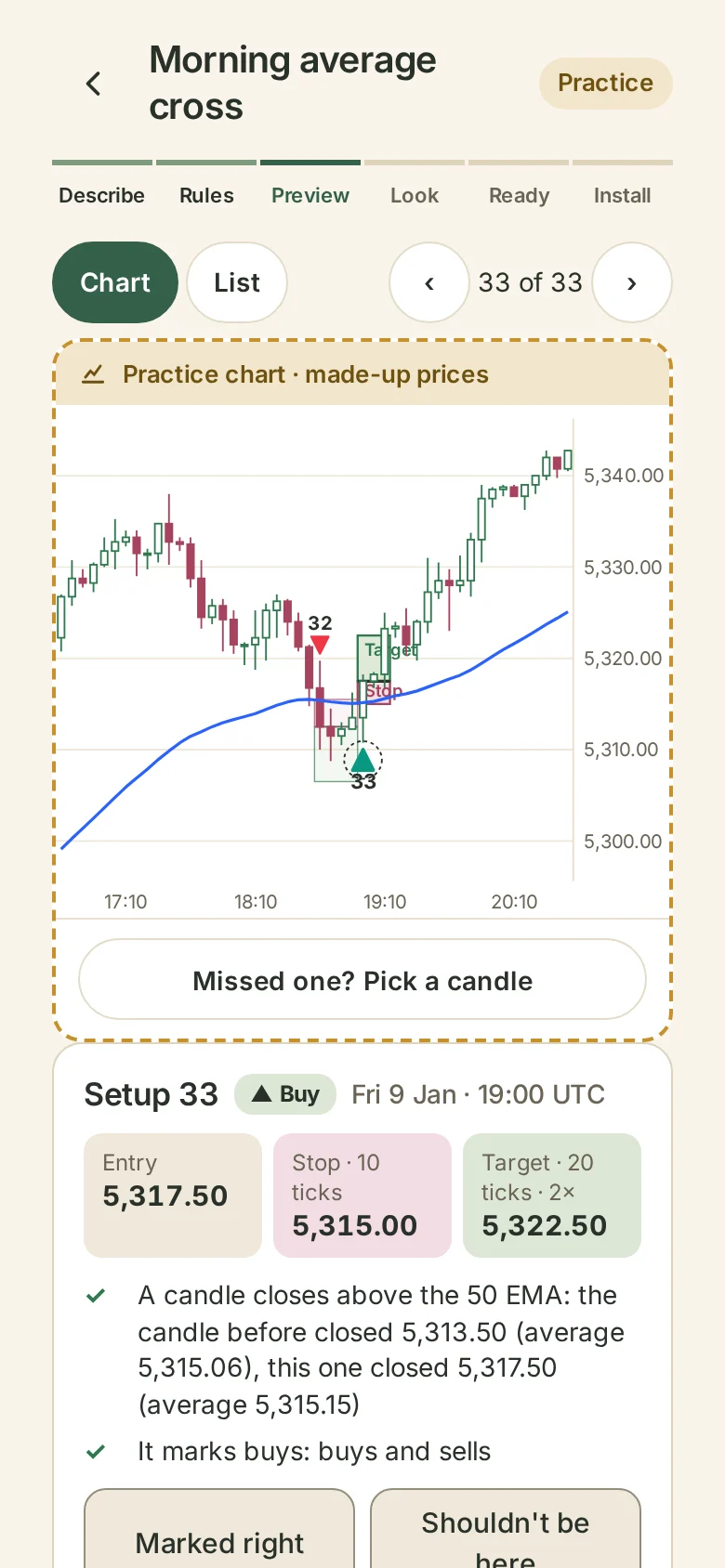
Try it free. You only pay when you add it to TradingView.
Common questions
What is a hammer candlestick?
A candle with a small body near its top and a long lower wick, at least twice the body in Nison’s definition, that forms after a fall.
What’s the difference between a hammer and a pin bar?
A pin bar is any candle with one long wick and a small body at the other end. A hammer is a pin bar with a long lower wick that comes after a fall.
What’s the difference between a hammer and a hanging man?
Nothing in the shape. A hammer comes after a fall, and a hanging man after a rise.
What is a shooting star candle?
A candle with a small body near its bottom and a long upper wick, after a rise.
Does a hammer have to be green?
No. A hammer can close green or red. The long lower wick and where the body sits decide it.
How long does the wick need to be?
Nison uses at least twice the body. Others use three times or more. The number is your choice.
Is a hammer bullish?
It’s called bullish because it comes after a fall and shows price coming back up from the low. It doesn’t tell you price will rise.
What is an inverted hammer?
The shooting star shape, a long upper wick and a small body near the bottom, after a fall.
Do pin bars work on futures?
They form on any candle chart, including futures, because they only need one candle’s open, high, low and close.