
Weekly VWAP, swing VWAP, ADR and time-of-day volume
Wildflower Trading School · Lesson 2.4.8.12 · This exercise is free

This lesson works towards your own indicator strategy: a signal and a filter you chose from Studio's indicators, every number yours, checked trade by trade, and drawn on your own chart platform. Today is line two: numbers counted in days, not candles.
1 of 9
What you'll learn
- ADR's length counts days, from 1 to 14, not candles.
- The bands sit an ADR above and below the open, so their width is two ADRs.
- Bands wider than 800 ticks means an ADR over 400 ticks.
- Inside the bands took all 18 trades. Price rarely leaves them.
Exercise
- Write line 2, for example: ADR 5 days, bands further apart than a number of ticks.
- Work out your width. Look at a typical day's range on your chart in ticks, and double it.
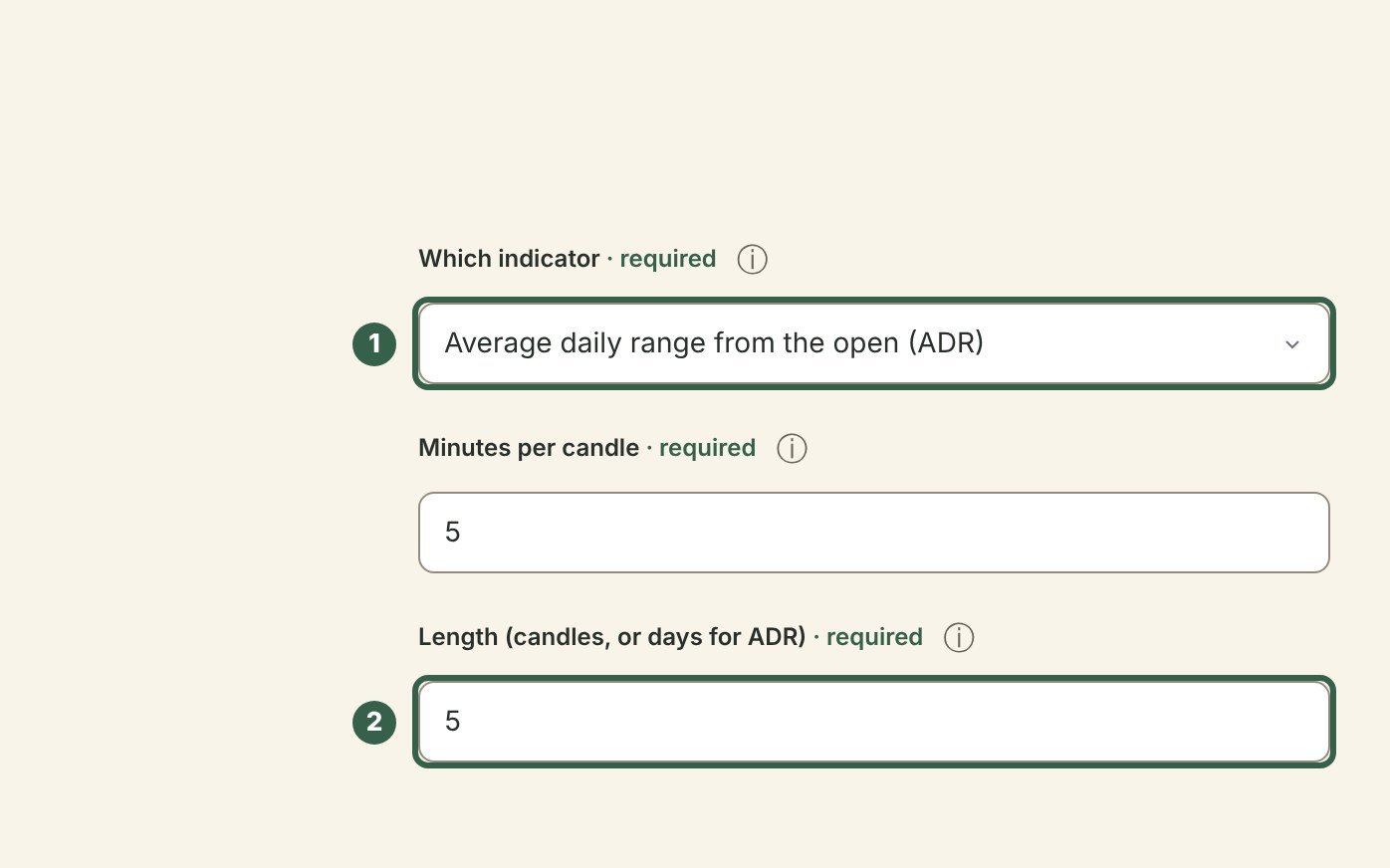
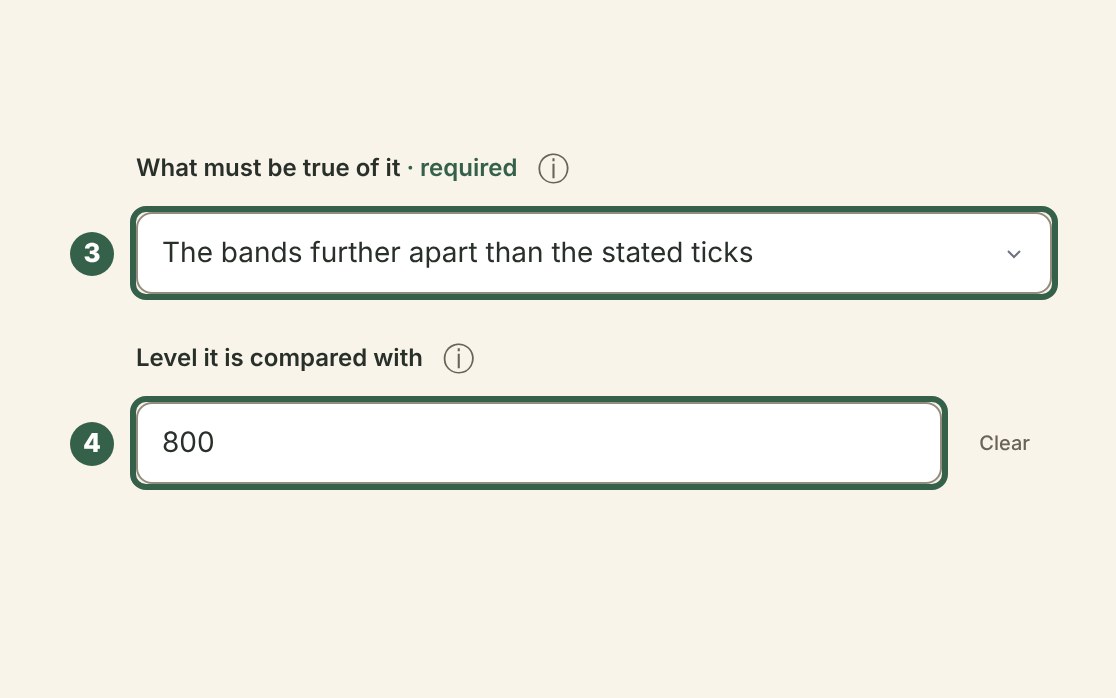
- Open your strategy in Strategies and press Change a rule. Open the Filter step, change Which indicator to ADR, and pick The bands further apart than the stated ticks.
- Click into Length (candles, or days for ADR), press Help me choose, and run 3, 5 and 10 days under Try a few.
- Change the condition to The candle inside the bands and run it once, to see whether it skips anything.
- Help article Weekly VWAP, swing VWAP, ADR and volume by time of day in Studio
- Help article The indicator condition gate
- Help article Help me choose a setting
Quick check
1. An ADR row's length is 5. What does 5 count?
2. What is the ADR row's level of 800 in?
3. Inside the bands took all 18 trades. What does it mean?
0 of 3 answered.
Finished this lesson?
Tick it off and keep your place
Read the full notes
The average daily range (ADR) is how far price has moved from low to high on an average day. Wildflower draws its bands above and below the day's open, by the ADR of your last whole days, from 1 to 14. So its length counts days, not candles, and so does time-of-day volume. In Wildflower, press Change a rule, open the Filter step, change Which indicator to ADR and type the days. A row can ask for the bands further apart than a number of ticks, which skips quiet days. Bands 800 ticks apart means an ADR of 400 ticks.
What you're building. A lesson towards your own indicator strategy: a signal and a filter you chose from Studio's indicators, every number yours, checked trade by trade, and drawn on your own chart platform. Last lesson changed the signal. Today is line 2 with lengths in days. Next lesson chooses the price an average reads.
| My indicator rule |
|---|
| 1. The signal: … (which indicator, and what it must do) |
| 2. The signal's numbers: … candles, …-minute candles, the price it reads … |
| 3. The filter: … (which indicator, must hold or must not, buys, sells or both) |
| 4. The filter's level: … in its own unit |
| 5. Stop … ticks, target … times the stop, $… a trade, … to … New York |
| 6. The wait: my strategy needs … candles before it can trade |
| 7. Checked: … trades gone through, and on my platform: … |
Why. Sam is made up, and so are his numbers. The same 80 tick target is a big ask on a narrow day and an easy one on a wide day. The average daily range measures that over your last whole days, so its length counts days, not candles.
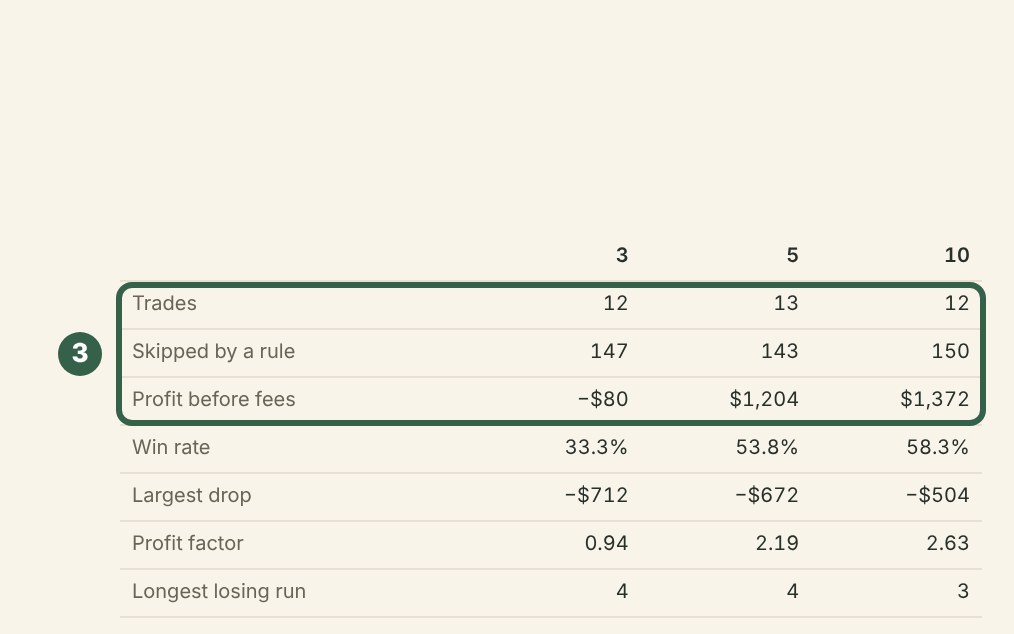
| ADR, bands wider than 800 ticks | No filter | 3 days | 5 days | 10 days |
|---|---|---|---|---|
| Trades | 18 | 12 | 13 | 12 |
| Won | 9 | 4 | 7 | 7 |
| Profit before fees | $1,332 | -$80 | $1,204 | $1,372 |
| ADR 5 days | Wider than 400 | Wider than 800 | Wider than 1,600 | Inside the bands |
|---|---|---|---|---|
| Trades | 18 | 13 | 0 | 18 |
Working out the width. The bands sit one ADR above and one below the day's open, so the width is two ADRs. For an ADR of at least 400 ticks, type 800. On gold at 10 cents a tick, 400 ticks is 40 dollars from low to high.
How traders use daily ranges. We can't tell you which to choose. These are the common uses. Skipping entries near a band, where an average day has little room left. Targets at or inside the bands (Studio's moving target can use them). Or trading busy days only, with a width.
Worked example
Made-up numbersReading Sam's ADR row
Sam is made up. Buys only. His filter is ADR 5 days, the bands further apart than 800 ticks.
- Gold's last five days ranged 380, 420, 350, 400 and 390 ticks. The average is 388.
- The bands sit 388 ticks each side of today's open, 776 ticks apart. 776 isn't more than 800, so the filter says no all day.
- After a busy week the average is 450. The bands are 900 ticks apart, and the trade is taken.
The filter reads the last five days and makes one decision for the whole of today.
Trading is risky. You can lose money. This lesson shows how Wildflower works. It isn't advice.