
Write up each trade in your Journal
Wildflower Trading School · Lesson 5.3.4.1 · This exercise needs a Trade subscription

This is step one of four in a weekly review routine in Wildflower: journal each trade, read your rule breaks, change one thing, and check it next week. By the end of the four you'll have a weekly review you repeat. Today you write up each trade and each day, so your review has something true to read.
1 of 12
What you'll learn
- Open the day in Journal. Every trade on your account is already there.
- Tag each trade with the same few words every time, like Took it early.
- Write a short note on why you went in and how it went.
- Score the day from 1 to 5 for how well you followed your plan, not for the money.
- Read Results by tag to see what each habit made or lost.
Exercise
- Choose Trade or Automate on Plans, if you haven't.
- Open Journal and open a day you traded.
- Open each trade. Type your Tags, with commas between, and a short Note.
- Score the day from 1 to 5 under How well did you follow your plan?, and write a line in Notes.
- On Friday, read the Week column and your scores. Write lines 1 and 2 of your weekly review in that day's Notes.
- Read Results by tag at the bottom of the month.
- Help article Your journal
Quick check
1. What does the 1 to 5 score in Journal measure?
2. You tag one trade Took it early and another took early. What does Results by tag show?
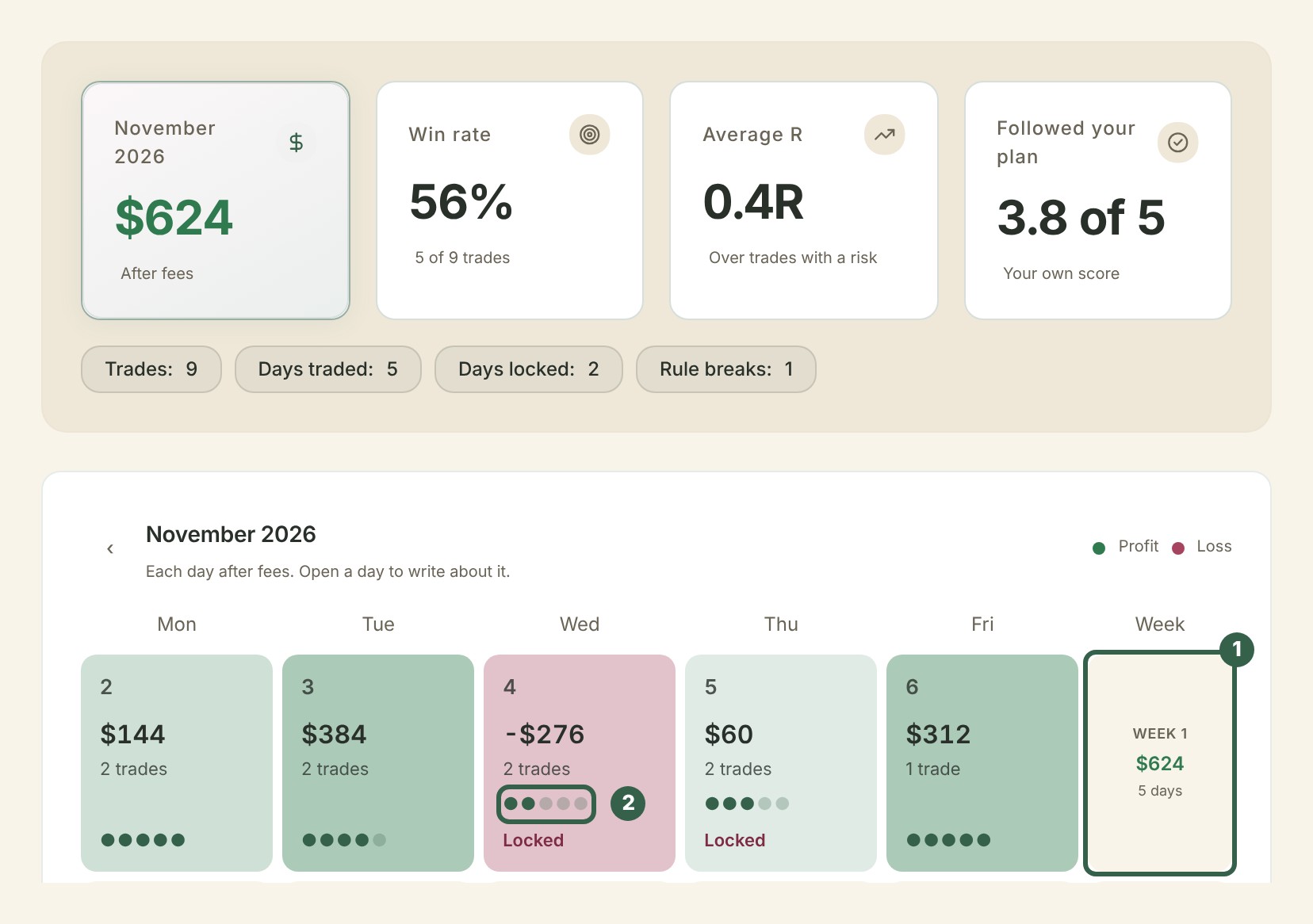
3. Sam's week: +$144, +$384, −$276, +$60, +$312. What did the week make?
0 of 3 answered.
Finished this lesson?
Tick it off and keep your place
Read the full notes
In Wildflower, every trade on your connected account lands in Journal on its own. Open the day, open each trade, and add tags and a note in your own words. Then score the day from 1 to 5 under How well did you follow your plan? Results by tag adds up each tag, and your week's scores and notes become the first two lines of your weekly review.
What you're building. This is step 1 of 4 of a weekly review routine in Wildflower: journal each trade, read your rule breaks, change one thing, and check it next week. By the end you have a weekly review you repeat. Today you write up each trade and each day, which gives you lines 1 and 2.
| Weekly review |
|---|
| 1. My week: result after fees …, scores … |
| 2. My lowest-scored day, and what my notes say: |
| 3. Rule breaks: Today's rules …, my own … |
| 4. What they cost: |
| 5. One change for next week: |
| 6. Last week's change: did I keep it? What changed? |
Why. Memory keeps how a trade felt, not what it made. A tag can be added up, and a score from 1 to 5 splits the losses your plan expects from the ones you caused (Judging decisions, not outcomes). What to write is in What to record in a journal and Keeping a trade journal. Sam is made up, and so are his numbers: micro gold, 4 contracts, $160 at his stop, $320 at his target, about $8 of fees a trade.
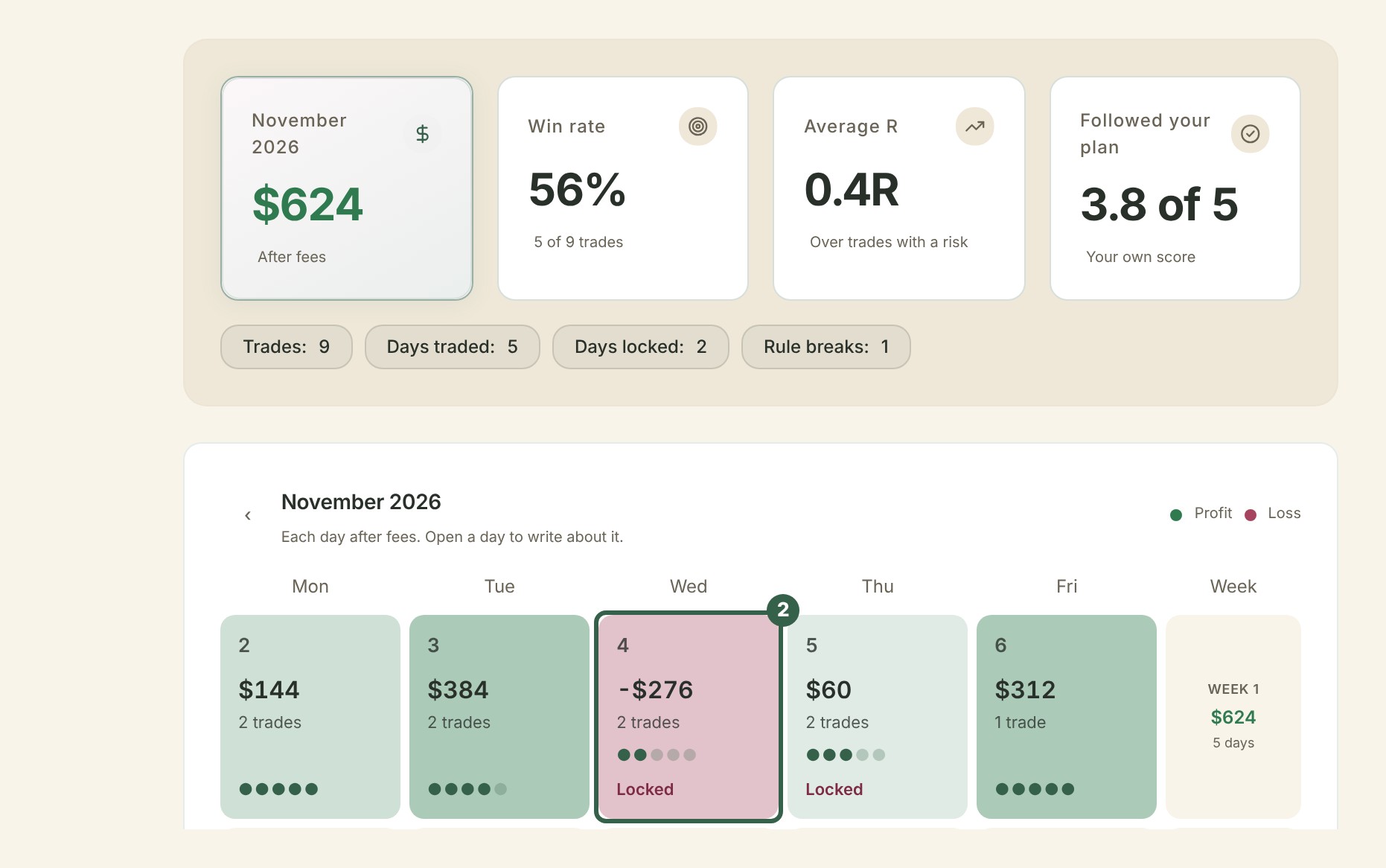
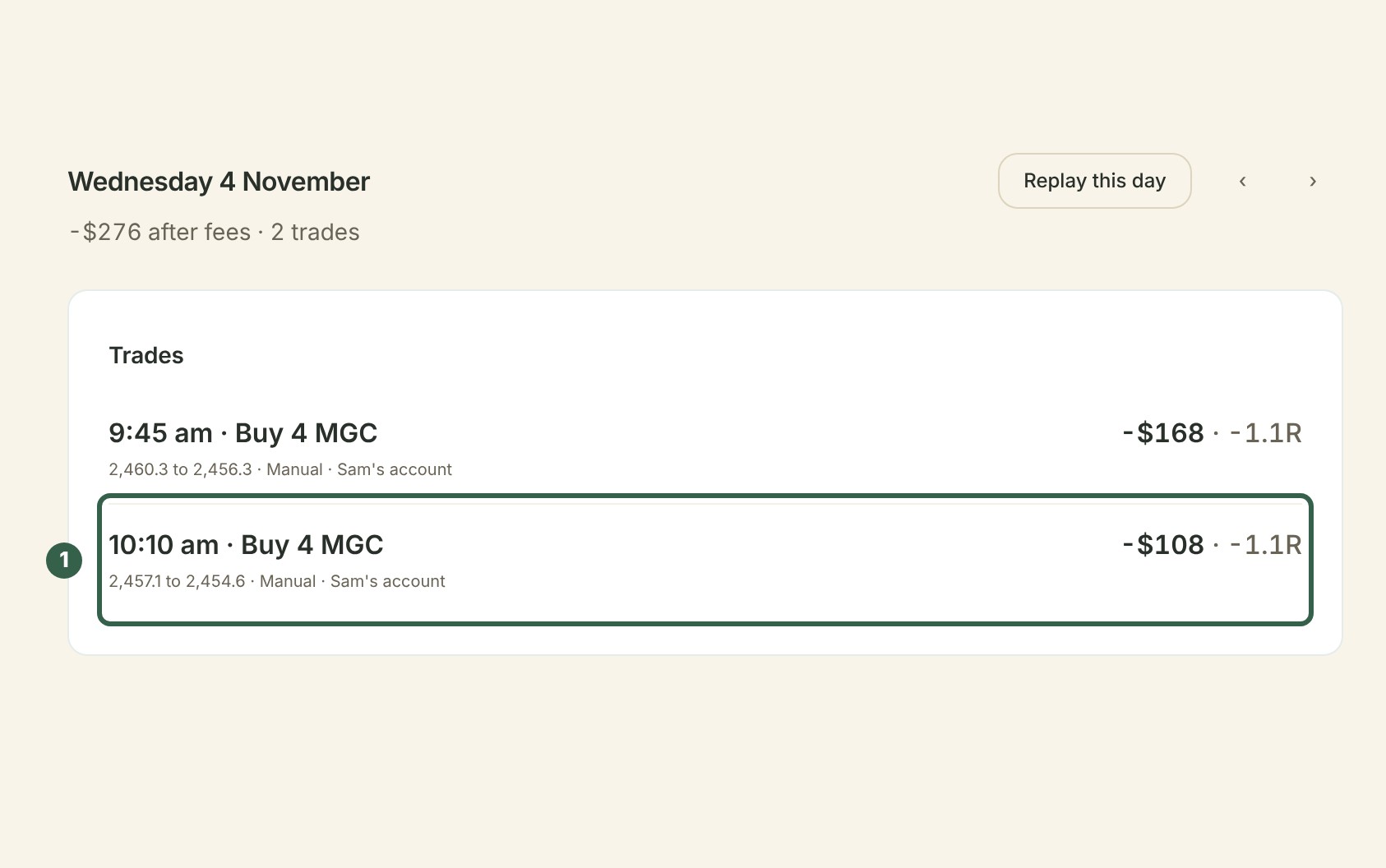
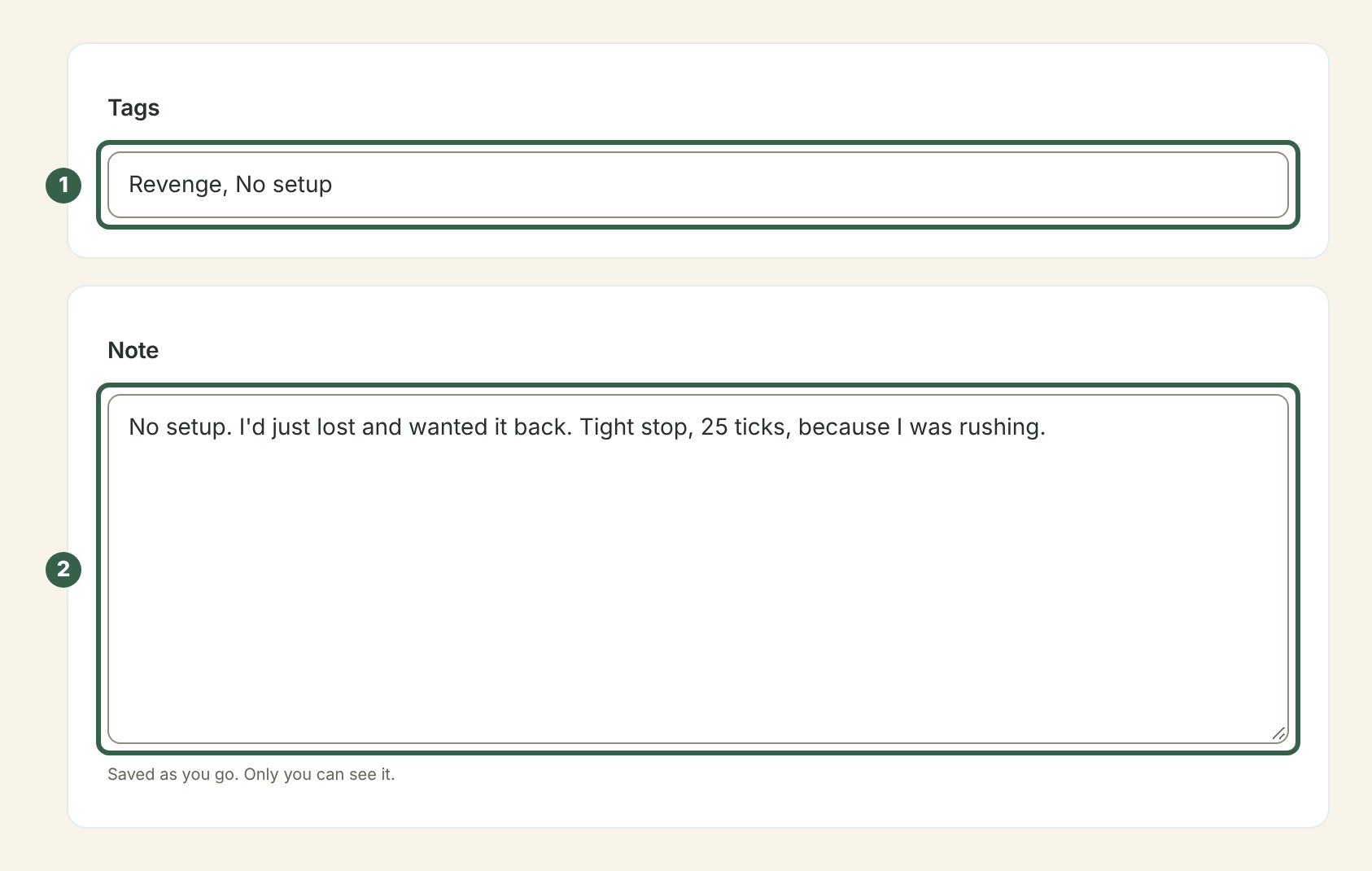
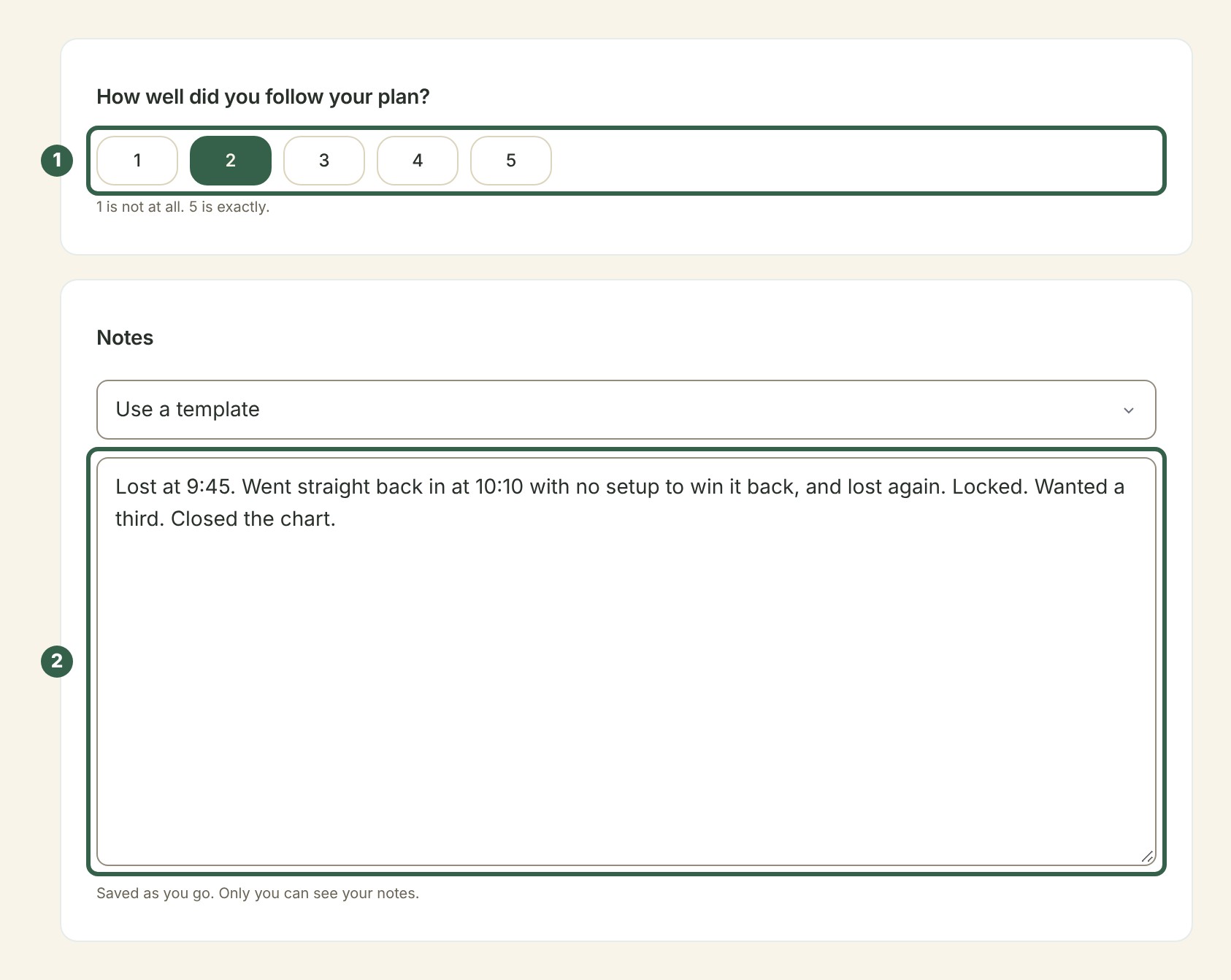
- Every trade is already there. Trades on your connected account land in Journal by themselves, placed by you or by the Bot.
- R. The result after fees divided by what the trade risked. Risked comes from the trade's stop.
- Tags. Your own words, with commas between. Use the same words every time.
- Score. 1 is not at all, 5 is exactly. Score how you followed your plan, not what you made. More in Top-down, part 4.
- Screenshots. Add a picture of your chart to a trade or a day. See Screenshots and notes after each trade.
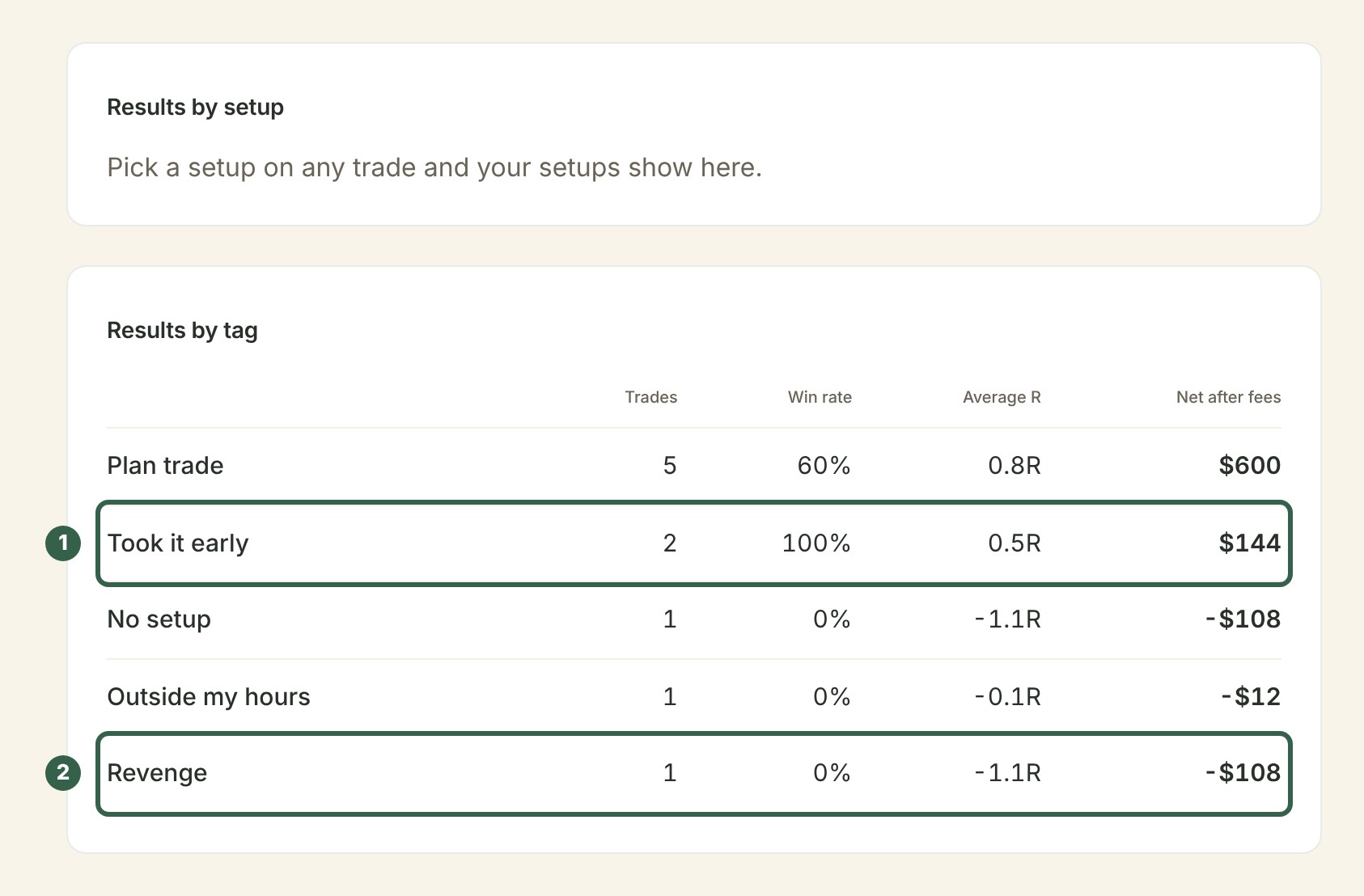
How traders use tags. We can't tell you which to choose. These are the common choices. Some tag what they did (Took it early, Revenge, Moved my stop). Some tag what they saw (a news day, the first hour). Some keep a short fixed list of five or six tags, so each tag has enough trades to tell them something.
On practice money it's free: with no broker, Journal's See your practice shows your practice trades. A trade's tags and note, a day's score and notes, Results by tag and Today's rules all work there. Templates, Your rule breaks and Days locked need a broker account and the Trade subscription.
Worked example
Made-up numbersSam's lines 1 and 2
Sam is made up. His first week of November, after fees: Mon +$144, Tue +$384, Wed −$276, Thu +$60, Fri +$312. His scores: 5, 4, 2, 3, 5.
- The week: $144 + $384 − $276 + $60 + $312 = $624.
- His lowest score is Wednesday, a 2.
- Wednesday's note: lost at 9:45, went straight back in at 10:10 with no setup to win it back, and lost again.
Line 1: My week: +$624 after fees. Scores 5, 4, 2, 3, 5. Line 2: Lowest-scored day: Wednesday, 2. Lost, then went back in with no setup to win it back.
Trading is risky. You can lose money. This lesson shows how Wildflower works. It isn't advice.