
Stop the revenge trade with Losses in a row
Wildflower Trading School · Lesson 5.2.5.1 · This exercise needs a Trade subscription

This is step three of four in a weekly review routine in Wildflower: journal each trade, read your rule breaks, change one thing, and check it next week. Today you check the rule that stops a revenge trade, and then you pick the one thing you'll change next week.
1 of 9
What you'll learn
- Read each losing day in order, top to bottom, in Journal.
- Find where your trading changed, like a trade right after a loss with no setup.
- Check your lock held. Look at Losses in a row and the day's loss on Today's rules.
- A smaller number starts straight away. A bigger one starts the next trading day.
- Write one change as line 5 of your weekly review.
Exercise
- Choose Trade or Automate on Plans, if you haven't.
- Open Journal on Friday and open each day that lost. Read its trades in order.
- Open Today's rules and check your Losses in a row number.
- To change it, type a new number in Losses in a row and press Save.
- Write line 5 of your weekly review, one change for next week, in Friday's Notes.
- Help article Today's rules
- Help article Your journal
Quick check
1. Sam's Losses in a row is 2. He loses at 9:45 and again at 10:10. What happens?
2. You change Losses in a row from 2 to 3. When does it start?
3. Sam's Wednesday: −$168, then −$108. What did the day lose?
0 of 3 answered.
Finished this lesson?
Tick it off and keep your place
Read the full notes
In Wildflower, open each losing day in Journal and read its trades in order, to find where your trading changed after a loss. Then check Today's rules: Losses in a row locks you after that many losing trades in a row, until the next trading day starts at 6 pm New York time. If your lock held, your one change comes from your biggest rule break. Write it as line 5 of your weekly review.
What you're building. This is step 3 of 4 of a weekly review routine in Wildflower: journal each trade, read your rule breaks, change one thing, and check it next week. Today gives you line 5.
| Weekly review |
|---|
| 1. My week: result after fees …, scores … |
| 2. My lowest-scored day, and what my notes say: |
| 3. Rule breaks: Today's rules …, my own … |
| 4. What they cost: |
| 5. One change for next week: |
| 6. Last week's change: did I keep it? What changed? |
Why. A revenge trade is a trade to win back a loss. It often comes minutes after the loss, with no setup (Revenge trading, Tilt). Losses in a row locks you after that many losing trades in a row, so the revenge trade can't grow into three or four (Discipline is a system, not willpower). How each rule counts and locks is in Cap your day with Today's rules. Sam is made up, and so are his numbers: micro gold, 4 contracts, $160 at his stop, $320 at his target, about $8 of fees a trade.
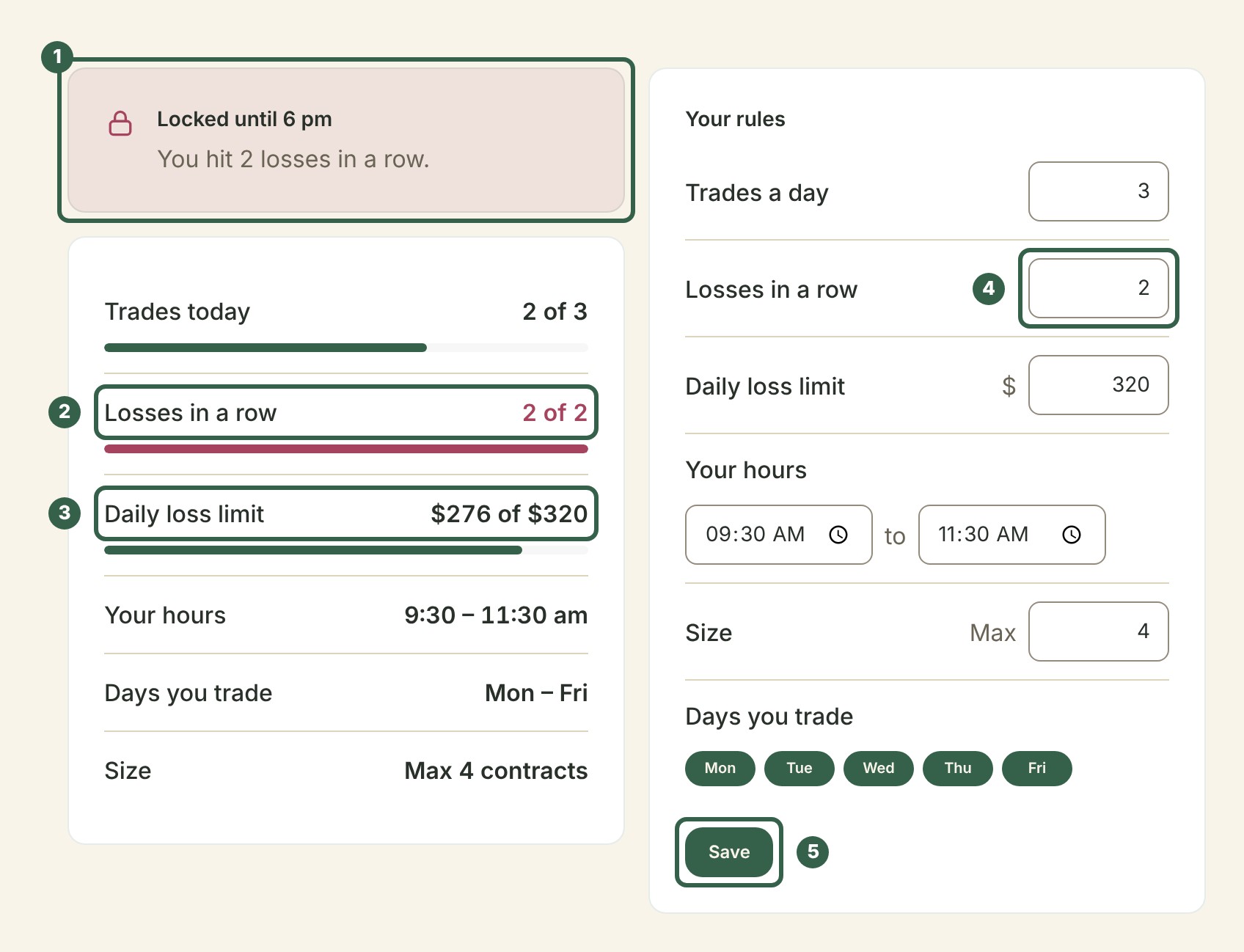
- Losses in a row counts losing trades in a row. A win starts it again, and so does each new trading day.
- Locked lasts until the next trading day starts, at 6 pm New York time. You can't turn it off early.
- A smaller number starts straight away. A bigger one starts the next trading day.
- One change at a time, so next week you can tell if it worked. See Turning a review into one change.
Losses in a row: the common choices. We can't tell you which to choose. These are the common choices. Some traders pick 1, so the trade after a loss never happens. Some pick 2, so one normal loss doesn't end the day. Some pick 3 when their plan often takes three trades, and leave the daily loss limit to stop the day.
On practice money it's free: with no broker, Journal's See your practice shows your practice trades. A trade's tags and note, a day's score and notes, Results by tag and Today's rules all work there. Templates, Your rule breaks and Days locked need a broker account and the Trade subscription.
Worked example
Made-up numbersSam's Wednesday, and line 5
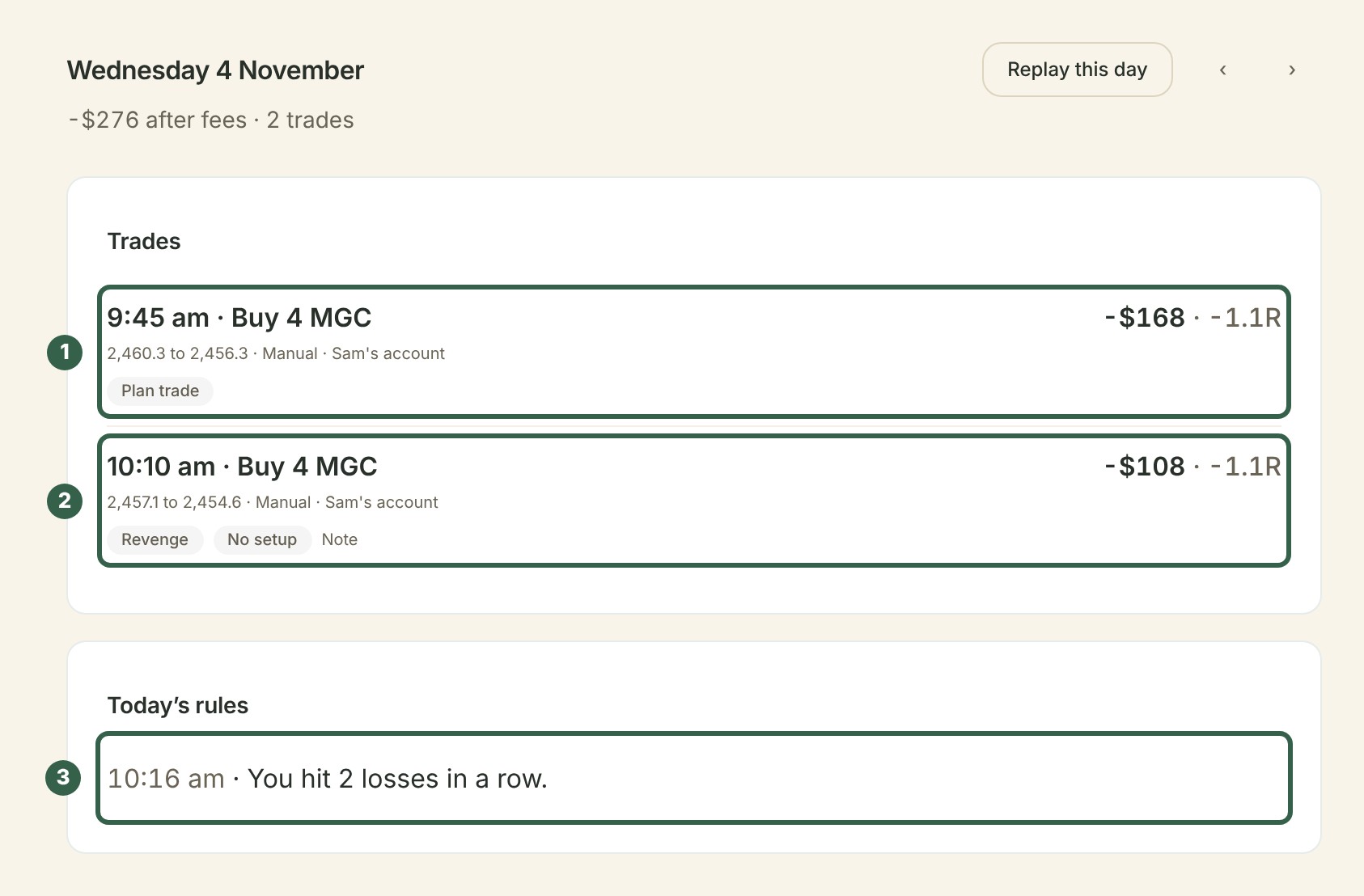
Sam is made up. Losses in a row 2, daily loss limit $320. Wednesday 4 November: 9:45 −$168 (a plan trade), 10:10 −$108 (Revenge, No setup). Step two found closing early cost −$480, his biggest rule break.
- After 10:10 he has 2 losses in a row, so he's locked until 6 pm.
- The day: −$168 − $108 = −$276, inside his $320 limit. No third trade. His 2 held.
- So his one change comes from his biggest cost: closing early.
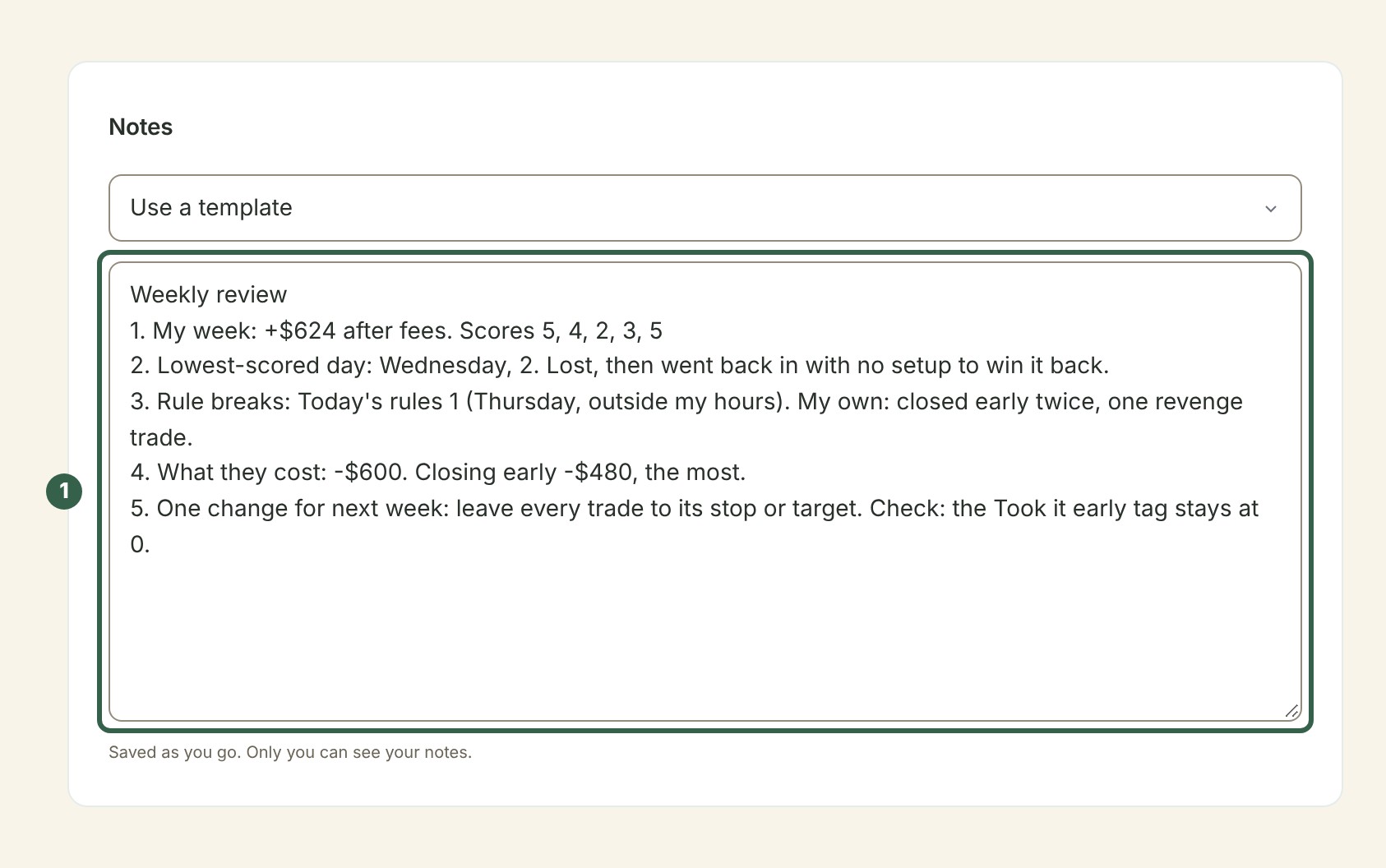
Line 5: One change for next week: leave every trade to its stop or target. Check: the Took it early tag stays at 0.
Trading is risky. You can lose money. This lesson shows how Wildflower works. It isn't advice.