
ICT Silver Bullet: what it is, the times, and how it’s taught
By Bec, futures trader and founder of Wildflower · Updated
The ICT Silver Bullet is a setup taught by Inner Circle Trader, a trading educator whose names for chart patterns, like fair value gap, are now widely used.More in the glossary: a A price range that a fast move skips over, found with three candles in a row whose first and third wicks don’t overlap.More in the glossary that forms inside a set one-hour window of clock time, and price coming back into it. The window given most often is 10:00 to 11:00 am New York time. Others are 3:00 to 4:00 am and 2:00 to 3:00 pm, and sources give slightly different rules.
What the Silver Bullet is, and why it’s called that
The Silver Bullet joins two ICT ideas. The first is time: a one-hour window you mark on the chart, the same hour every day. The second is a fair value gap: a price range that a fast move skips over, found with three One bar on a price chart. It shows where price opened and closed, and the highest and lowest it reached, in one stretch of time.More in the glossary in a row. Read about fair value gaps.
Put together, the setup is a fair value gap that forms inside the hour. ICT traders then wait for price to come back into the gap. Only one hour of the day is watched, and anything outside it is ignored.
A “silver bullet” is an old saying for one simple answer to a hard problem. ICT chose the name for a short, fixed routine: one hour, one kind of setup. The name is a label. It isn’t evidence that the setup does anything.
ICT Silver Bullet times, in New York time
These are the three windows ICT is most often quoted as giving. They’re in New York time, the clock ICT uses. Each is one hour long.
- 3:00 to 4:00 am. Often called the London Silver Bullet. It sits inside the London An ICT name for a window of clock time around a big session’s open, such as 2:00 to 5:00 am New York time. Sources give slightly different times.More in the glossary, 2:00 to 5:00 am.
- 10:00 to 11:00 am. Often called the New York morning, or AM, Silver Bullet. It’s the one named most often, and it starts as the New York kill zone ends.
- 2:00 to 3:00 pm. Often called the New York afternoon, or PM, Silver Bullet.
Sources don’t all agree. Some only teach the 10:00 am window. Some move an edge, or add a window. There’s no official list. New York time also shifts against other clocks for a few weeks each spring and autumn, as the kill zones page explains. Which hours you watch is your choice.
How the Silver Bullet is taught, step by step
1. Mark the hour
Set your chart to New York time and mark 10:00 to 11:00. Many ICT traders use 1- to 5-minute candles here.
2. Mark the highs and lows nearby
An earlier high or low that price may head for. ICT calls it the In ICT’s terms, the price that price may be heading for next, such as an earlier high or low where orders may be waiting.More in the glossary.
3. Wait for a gap inside the hour
Three candles in a row, inside the window, whose first and third wicks don’t overlap.
4. Watch price come back
At 10:30, a candle’s low reaches into the gap. That return is the moment the setup is taught around.
Sources then describe the trade in a similar way. The entry is a An order that only fills at a price you set or better. The price is promised, but a fill isn’t.More in the glossary at the edge of the gap, or at its halfway point. The stop goes beyond the low (or high) of the move that made the gap. The target is the earlier high or low from step 2. In the picture, that’s in at 101.75, a stop at the move’s low of 99.50, and a target at 103.50. These are descriptions of how it’s taught, not settings to use.
Many versions add rules of their own. Some want a A quick move past an earlier high or low that then closes back inside it.More in the glossary first: a wick past an earlier high or low that closes back inside, like the 10:05 candle here. Some want a set distance to the target. Some allow one trade per window. Each of those is a choice, and sources differ.
Bullish and bearish Silver Bullets
Bullish. A move up inside the hour leaves a Rising, or expecting a rise. A bullish candle closed higher than it opened.More in the glossary fair value gap. Price dips back into it from above. The target is an earlier high.
Bearish. A move down inside the hour leaves a Falling, or expecting a fall. A bearish candle closed lower than it opened.More in the glossary gap. Price rises back into it from below. The target is an earlier low.
Some traders only look one way on a given day, depending on which earlier high or low they think price is heading for. That’s their own read, and the Silver Bullet itself doesn’t decide it.
What counts, and what doesn’t
The gap forms inside the hour. Most versions only count a gap whose third candle closes after the window opens. A gap from 9:50 is outside the 10:00 window, even if price returns to it at 10:05. Some traders count it anyway. There’s no single rule.
The return comes inside the hour. A gap from 10:50 that price only reaches at 11:05 is outside the window, because the hour has ended.
A close through the gap ends it. If a candle closes past the far side before a clean return, the gap is no longer there to come back to. Some traders then watch it as an A fair value gap that a candle has closed through, then watched from the other side.More in the glossary, which is a different idea.
The candle size matters. A gap on a 1-minute chart may not show on a 5-minute chart. The window has to be much longer than one candle, so a 1-hour chart can’t show it at all.
Wicks, not bodies. The gap is measured from the wicks of the first and third candles, exactly as any fair value gap is.
What can happen after price comes back
Both of these happen. Price can come back into the gap and head for the earlier high. It can also fall straight through the gap and past the stop. It can drift between the two until the hour ends.
A Silver Bullet shows where a gap formed and when. It doesn’t tell you what price does next, and no hour of the day is known to behave the same way every day.
Where the Silver Bullet comes from
The Silver Bullet comes from ICT (Inner Circle Trader), a trading educator whose names for chart ideas, such as fair value gap and kill zone, are now widely used. He taught it in his free videos, and it spread through trading forums and social media. That’s one reason the details vary: many people have retold it in their own words.
It’s taught on stock index futures and on forex alike. The windows stay in New York time whatever the market.
Often confused with
Kill zones. Longer ICT time windows, two to three hours each, around the big session opens. The Silver Bullet windows are one hour, and each has a fair value gap in it. Read about kill zones.
Judas swing. An ICT name for an early false move near a session’s open that runs one way and then turns. It’s about a move, not a gap. Read about the Judas swing.
Power of three. ICT’s idea that a session opens, runs one way, then moves the other way. Read about power of three.
Optimal trade entry (OTE). An ICT band of prices part way back along a move, measured with Fibonacci levels. It’s another ICT entry, but it doesn’t use a set hour. Read about optimal trade entry.
A Silver Bullet indicator for TradingView
Mark gaps and returns in the hours you choose
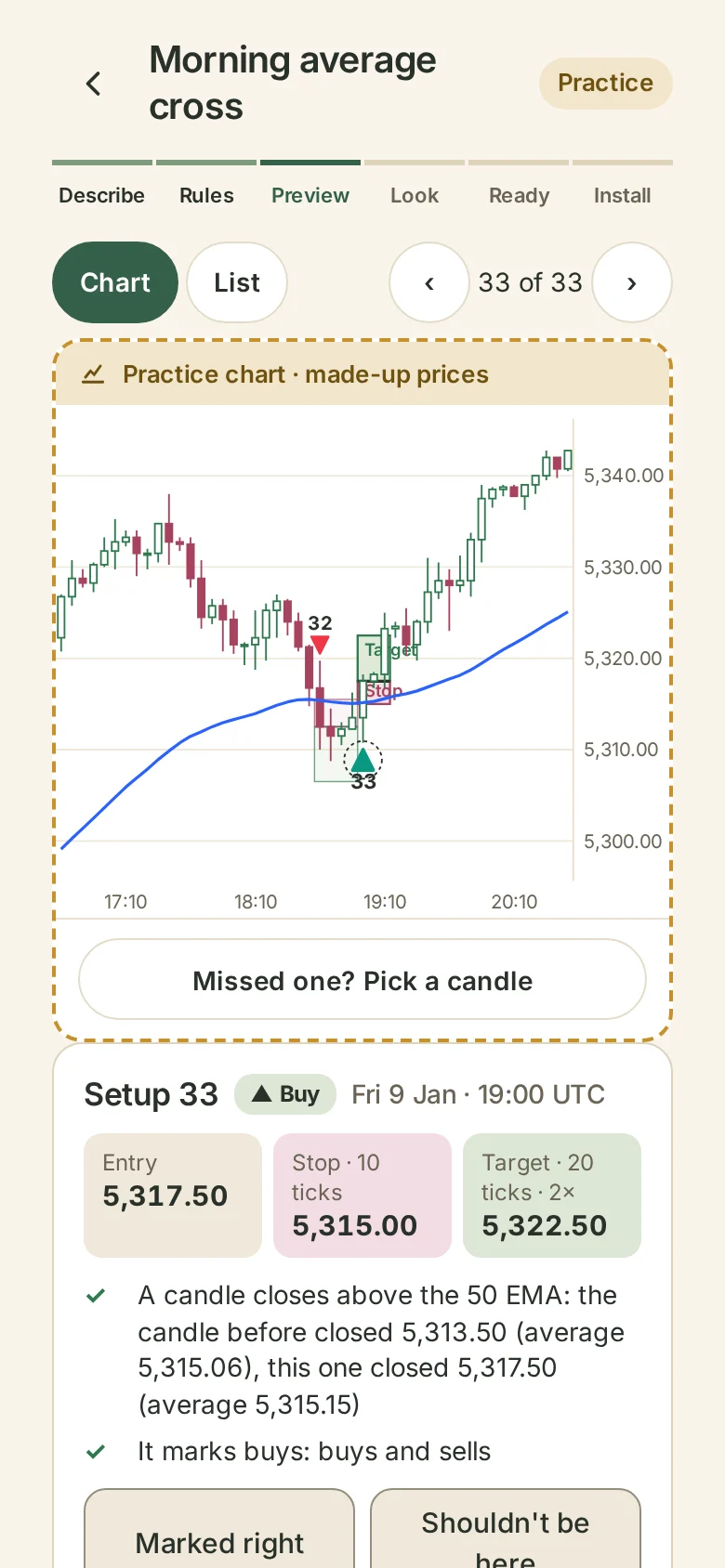
Wildflower’s Indicator marks things on a chart from rules you describe in plain words, with every number typed by you. It can mark fair value gaps and price coming back into one, with a minimum gap size you set. It can also keep its marks to the clock hours you choose, by switching off every other hour (it uses Chicago time, one hour behind New York). They’re whole hours, so 10 to 11 am New York works and a half-hour window doesn’t. It doesn’t know the Silver Bullet by name, so you give it the times. It can’t check that the gap itself formed inside the hour, only that the return did. Check it all on a chart for free, then add it to TradingView with a step-by-step guide.
Free to build
Common questions
What is the ICT Silver Bullet?
A setup taught by ICT: a fair value gap that forms inside a set one-hour window, and price coming back into it.
What time is the Silver Bullet?
The window named most often is 10:00 to 11:00 am New York time. ICT is also quoted as giving 3:00 to 4:00 am and 2:00 to 3:00 pm.
What is the Silver Bullet in London time?
10:00 to 11:00 am in New York is 3:00 to 4:00 pm in London for most of the year, and 2:00 to 3:00 pm for a few weeks each spring and autumn.
Which timeframe is used for the Silver Bullet?
Sources describe 1-minute to 5-minute candles, so the one-hour window holds many candles. The choice is yours.
Does the fair value gap have to form inside the window?
In most versions, yes. Some traders also count a gap from just before the hour. There’s no single rule.
Where does the stop go in a Silver Bullet?
Sources describe it beyond the low (or high) of the move that made the gap. Where you put a stop is your choice.
Is the Silver Bullet the same as a kill zone?
No. Kill zones are longer windows. The Silver Bullet is a one-hour window with a fair value gap in it.
Does the ICT Silver Bullet work?
No setup works every time, and this page makes no claim about results. A backtest on your own rules shows what they would have done in the past, which isn’t a promise about the future.
Can I get a Silver Bullet indicator for TradingView?
Wildflower’s Indicator can mark fair value gaps and returns into them, kept to the hours you choose. Preview it free, then pay only when you add it to TradingView. See the Indicator.
Learn it step by step in Wildflower Trading School, starting with the lesson “Short time windows inside a session”.