
Build a smart money zone trade
Wildflower Trading School · Lesson 3.2.29.22

In the Smart money concepts course you met rejection blocks, propulsion and vacuum blocks, mitigation blocks, liquidity voids and the unicorn. In Wildflower, each one is now its own block. By the end of this class you'll know how all six read the chart, and you'll have built one with every box filled in.
1 of 7
What you'll learn
- Pick a zone. Six blocks, one per smart money zone.
- Know the shared rule. Price leaves first, then a return counts.
- Say how long a zone is watched. In candles, typed by you.
- Compare versions. Change one box at a time.
Exercise
- Open Studio and open a strategy of your own, or start a new one.
- Choose + Add setup, pick Propulsion block and set Minutes per candle to the candles you watch.
- Type Candles each side of a swing and Candles a zone is remembered for, and pick body or whole candle.
- Set Price the stop is anchored to to The opposite band and save.
- Run it in Backtest on the Practice chart. Then save a version with another of the six blocks, such as Vacuum block, and run it too.
- Write down the trades, largest drop and longest losing run for each.
- Help article Equal highs and lows, liquidity sweeps, order blocks and breaker blocks
- Help article Help me choose a setting
Quick check
1. When does a return to a zone count?
2. A candle closes through a zone's far side. What happens?
3. What is The opposite band, as a stop for these blocks?
0 of 3 answered.
Finished this lesson?
Tick it off and keep your place
Read the full notes
Studio has six smart money zone blocks: rejection, propulsion, mitigation and vacuum blocks, the liquidity void and the unicorn. Each marks its zone by a fixed rule, and a return counts only after price has left the zone. You type how long a zone is watched and compare versions on the free practice chart.
Studio has six smart money zone blocks: Rejection block, Propulsion block, Mitigation block, Vacuum block, Liquidity void and Unicorn. The ideas are in Rejection blocks and the unicorn, Propulsion and vacuum blocks, Breaker blocks and mitigation and Balanced price ranges and liquidity voids.
One rule for all six. Price must leave a zone, a candle trading entirely clear of it, before a return counts. A return is a candle reaching back into the zone without closing through its far side. A close through the far side ends the zone. Each zone is read once, and forgotten after the number of candles you type.
- Rejection block. At a confirmed swing high, the swing candle's upper wick, from its body to its high, is a zone to sell from. At a swing low, its lower wick, to buy from.
- Propulsion block. The candle that reaches back into an The last candle that moved the other way before a strong move, often marked as a zone traders watch.More in the glossary without closing through it becomes a zone facing the same way, by its body or its whole range.
- Mitigation block. After a lower high, a close below the latest A dip on the chart: a candle whose low is below the lows of the candles on both sides of it.More in the glossary makes the last up candle since that lower high a zone to sell from. The mirror after a higher low buys.
- Vacuum block. A candle whose low is above the last candle's high, by at least the ticks you type, leaves a gap to buy from. The mirror sells.
- Liquidity void. A run of candles closing one way, at least as many as you type and at least as far, ends. Price must come back the share of the run you type, such as 50%.
- Unicorn. Where a new An order block that price has closed through, then watched from the other side.More in the glossary overlaps a A price range that a fast move skips over, found with three candles in a row whose first and third wicks don’t overlap.More in the glossary of at least the ticks you type, from the same move. The overlap is the zone.
- The stop. The opposite band is the zone's far side. You can also pick the zone's middle, the low or high of the candle that came back, a swing, or a set number of ticks.
One rule everywhere. Each block runs the same in Backtest, on your strategy's chart and in the Bot, and the script you copy to a platform marks the same zones.
More in the help articles Equal highs and lows, liquidity sweeps, order blocks and breaker blocks and Help me choose a setting.
Worked example
Made-up numbersSam's propulsion block, in numbers
These are made-up Micro Gold prices, where one tick is 0.1, worth $1 a contract. The propulsion block's body runs from 4,031.0 to 4,033.5, and price has left it.
- A candle dips to 4,032.4 and closes at 4,033.0, inside the zone and above its bottom. It's a buy at 4,033.0.
- The stop is the opposite band, 4,031.0, minus 2 ticks of room, at 4,030.8. That's 22 ticks, $22 a contract.
- His 2x target is 44 ticks away, at 4,037.4, $44 a contract. All before fees.
A buy from 4,033.0 with $22 at risk against $44. Numbers made up to show the sums.
Every box, filled in by Sam
Sam is made up. These are Sam's numbers. Choose your own.
| Box | Sam's choice | Why |
|---|---|---|
| Widest stop allowed | 80 ticks | He won't trade a stop wider than 8 points |
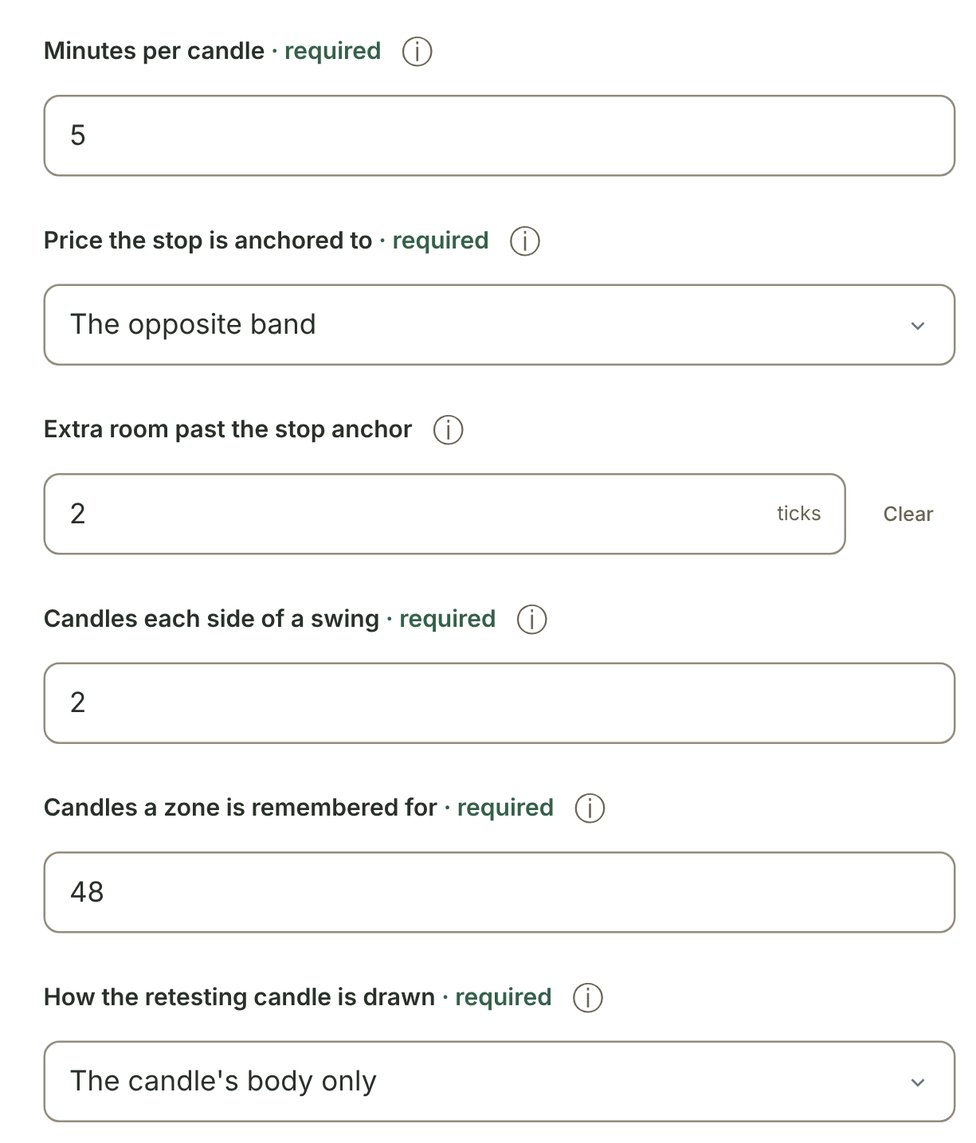
| Minutes per candle | 5 | The candles he watches for the signal |
| Buy, sell or both | Both sides | Zones form both ways |
| Price the stop is anchored to | The opposite band | The zone's far side |
| Extra room past the stop anchor | 2 ticks | A little room beyond the zone |
| Candles each side of a swing | 2 | How order blocks are found |
| Candles a zone is remembered for | 48 | Four hours on 5-minute candles |
| How the retesting candle is drawn | The candle's body only | A tighter zone than the whole candle |
How to choose your own
- Write the rule in words first, from the smart money lessons. Which zone, how long you'll watch it, and where the stop goes.
- Save each change as its own version, such as 48 candles and 96, and run them in Backtest on the practice chart.
- Compare the trades, the largest drop and the longest losing run, and read the drop and the run first.
Trading is risky. You can lose money. This lesson shows how Wildflower works. It isn't advice.