
Build a trade at the 52-week high and low
Wildflower Trading School · Lesson 3.2.29.26

In the levels course you met the 52-week high, the highest price of the last year. In Wildflower, Signal at a level can now read it, and its matching low. By the end of this class you'll know how Wildflower counts the 52 weeks, and you'll have built a trade on them with every box filled in.
1 of 8
What you'll learn
- Pick the levels. The 52-week high and low.
- Pick the action. A break, a bounce, a sweep or a retest.
- Use slow candles. 4-hour or daily, so the chart holds a year.
- Compare versions. Against last month's levels.
Exercise
- Open Studio and open a strategy of your own, or start a new one.
- Add Signal at a level, and pick 52-week high and low under Which levels to use.
- Pick what price does there, a break, a bounce, a sweep or a retest, and fill in every box marked required. Save.
- Run it in Backtest on the Practice chart, on 4-hour or daily candles so the chart holds more than a year.
- Save a version with last month's high and low instead, and run it too.
- Write down the trades, largest drop and longest losing run for each.
- Help article The levels Signal at a level can read
- Help article Week, month and 52-week levels on the Bot
- Help article Help me choose a setting
Quick check
1. Which weeks make the 52-week high?
2. A week in the year had two hours of candles missing. What happens?
3. On Micro Gold, a tick is 0.10 and worth $1. A buy at 3,504.6 with the stop at 3,486.6 risks how much a contract?
0 of 3 answered.
Finished this lesson?
Tick it off and keep your place
Read the full notes
Signal at a level can read the 52-week high and low, the highest high and lowest low of the 52 whole weeks before this one. They are read only once Wildflower has 52 whole weeks in a row, so the Bot waits until it has them.
The The highest price a market traded over the last year. The 52-week low is the lowest.More in the glossary and low are a choice in Signal at a level in Studio. The idea is in All-time and recent highs.
- The weeks. A futures trading week opens on Sunday at 5pm Chicago time and runs to Friday's close.
- The levels. The highest high and lowest low of the 52 whole weeks before this one. This week's own prices don't count yet.
- A new week. The week that ended joins and the oldest drops out.
- Only with 52 whole weeks in a row. A week with an hour or more of candles missing starts the count again.
- On the Bot. It loads 373 days each time it starts, and your computer keeps the candles it has seen. Until it has 52 whole weeks, it waits and makes no trades from these levels.
- On the chart. Your strategy's chart and the script you copy to a platform read the chart's own candles, so use a chart that holds more than a year, such as 4-hour or daily candles.
One rule everywhere. It runs the same in Backtest, on your strategy's chart and in the Bot, and in the script you copy to a platform.
More in the help articles The levels Signal at a level can read, Week, month and 52-week levels on the Bot and Help me choose a setting.
Worked example
Made-up numbersSam's 52-week break, in numbers
These are made-up Micro Gold prices, where one tick is 0.10, worth $1 a contract. The 52-week high is 3,500.0.
- A 4-hour candle closes at 3,504.6, 46 ticks past the high and more than his 4. A break up.
- He buys at 3,504.6 with the stop at that candle's low, 3,486.6. That's 180 ticks, $180 a contract.
- His 2x target is 360 ticks away, at 3,540.6, $360 a contract. All before fees.
A buy from 3,504.6 with $180 at risk against $360. Numbers made up to show the sums.
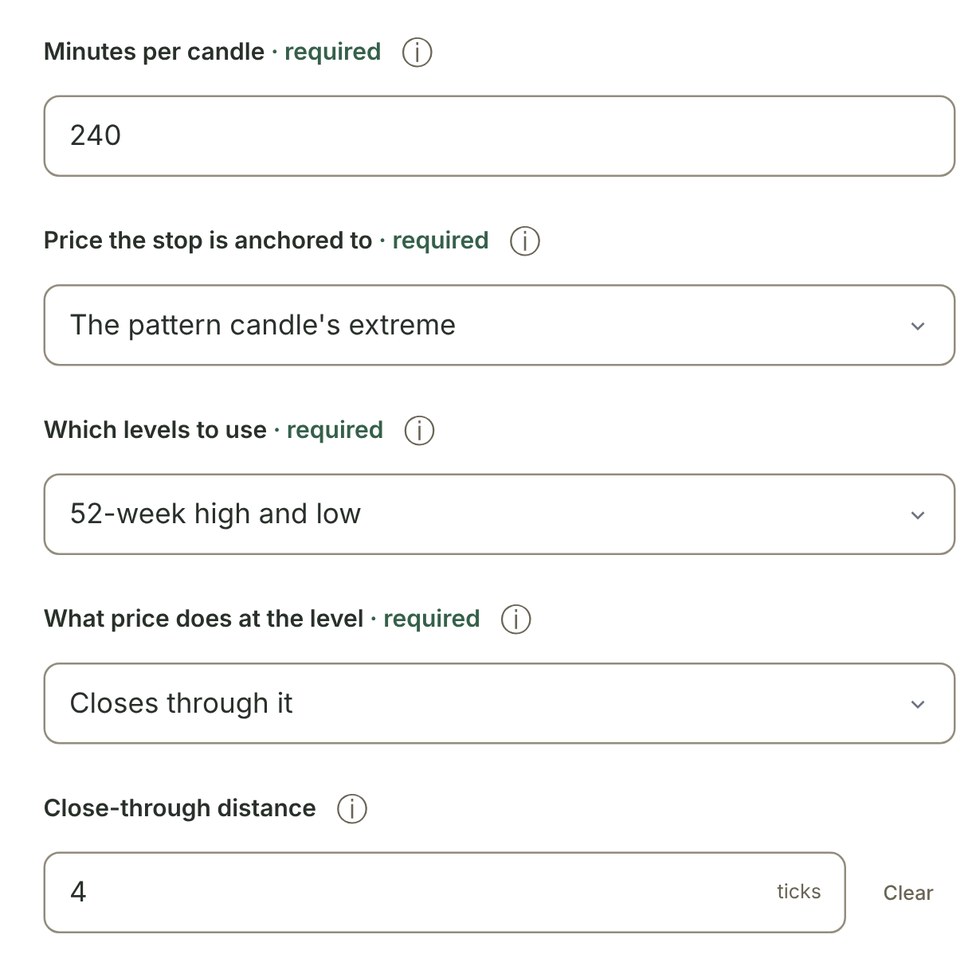
Every box, filled in by Sam
Sam is made up. These are Sam's choices. Choose your own.
| Box | Sam's choice | Why |
|---|---|---|
| Minutes per candle | 240 | A slow level, read on slow candles |
| Which levels to use | 52-week high and low | The year's edges |
| What price does at the level | Closes through it | He trades the break |
| Close-through distance | 4 ticks | A close barely past it isn't enough |
| Price the stop is anchored to | The pattern candle's extreme | The breakout candle's low for a buy |
| Widest stop allowed | 200 ticks | He skips wider breaks |
How to choose your own
- Write the rule in words first, from the lessons. Which action, how far past the level, and where the stop goes.
- Save each change as its own version, such as a break against a bounce, and run them in Backtest on the practice chart.
- Compare the trades, the largest drop and the longest losing run, and read the drop and the run first.
Trading is risky. You can lose money. This lesson shows how Wildflower works. It isn't advice.