
Build a trade at last week's or last month's levels
Wildflower Trading School · Lesson 3.2.29.16 · This exercise is free

Same goal as every lesson in this set: a setup card for every setup you trade: described in your own words in Wildflower, every number yours, one box tried three ways on the practice chart, and compared with a plain entry. By the end of today, you'll have Sam's weekly levels card filled in, and your own saved in Wildflower.
1 of 13
What you'll learn
- Describe your weekly levels in words from Strategies, then New strategy.
- Read the levels back on Check my rules, to see last week's high and low.
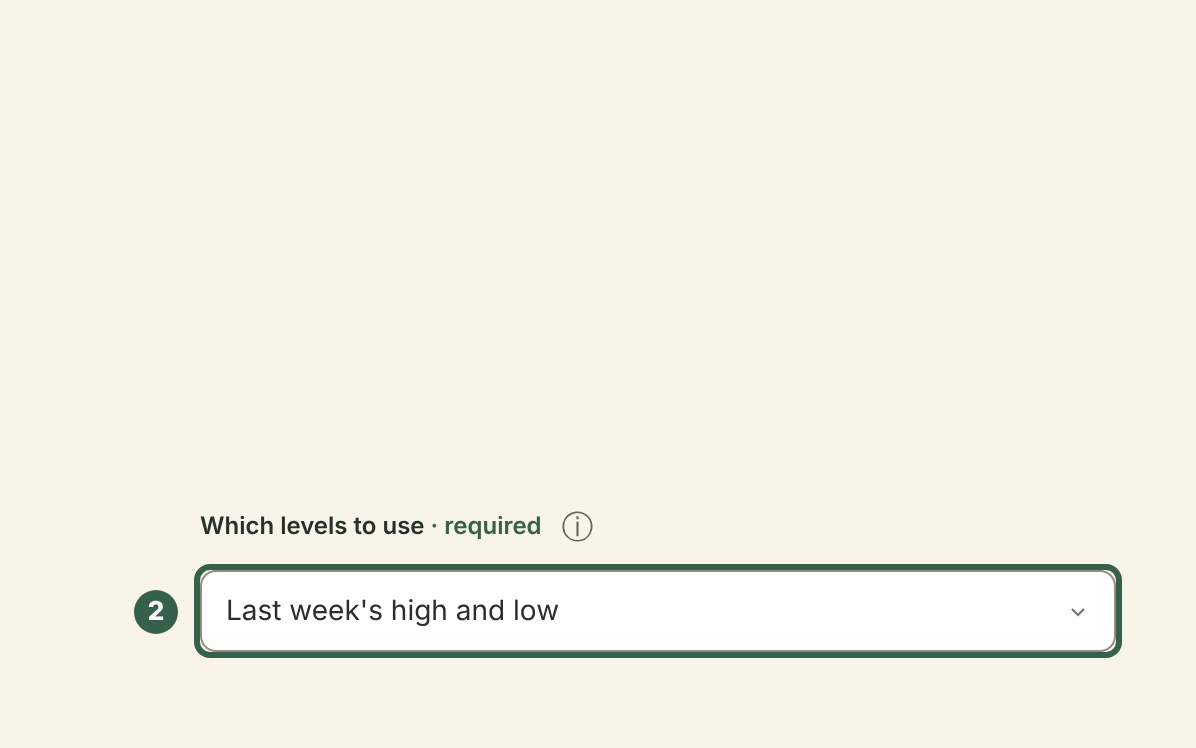
- Try day, week and month in Which levels to use with Try a few.
- 2 trades, or none, can't tell you anything yet.
- Compare with a plain 10:00 entry on the same days, after fees.
Exercise
- Start a new setup card: copy the seven lines above onto paper or into a note.
- Open Strategies and press New strategy.
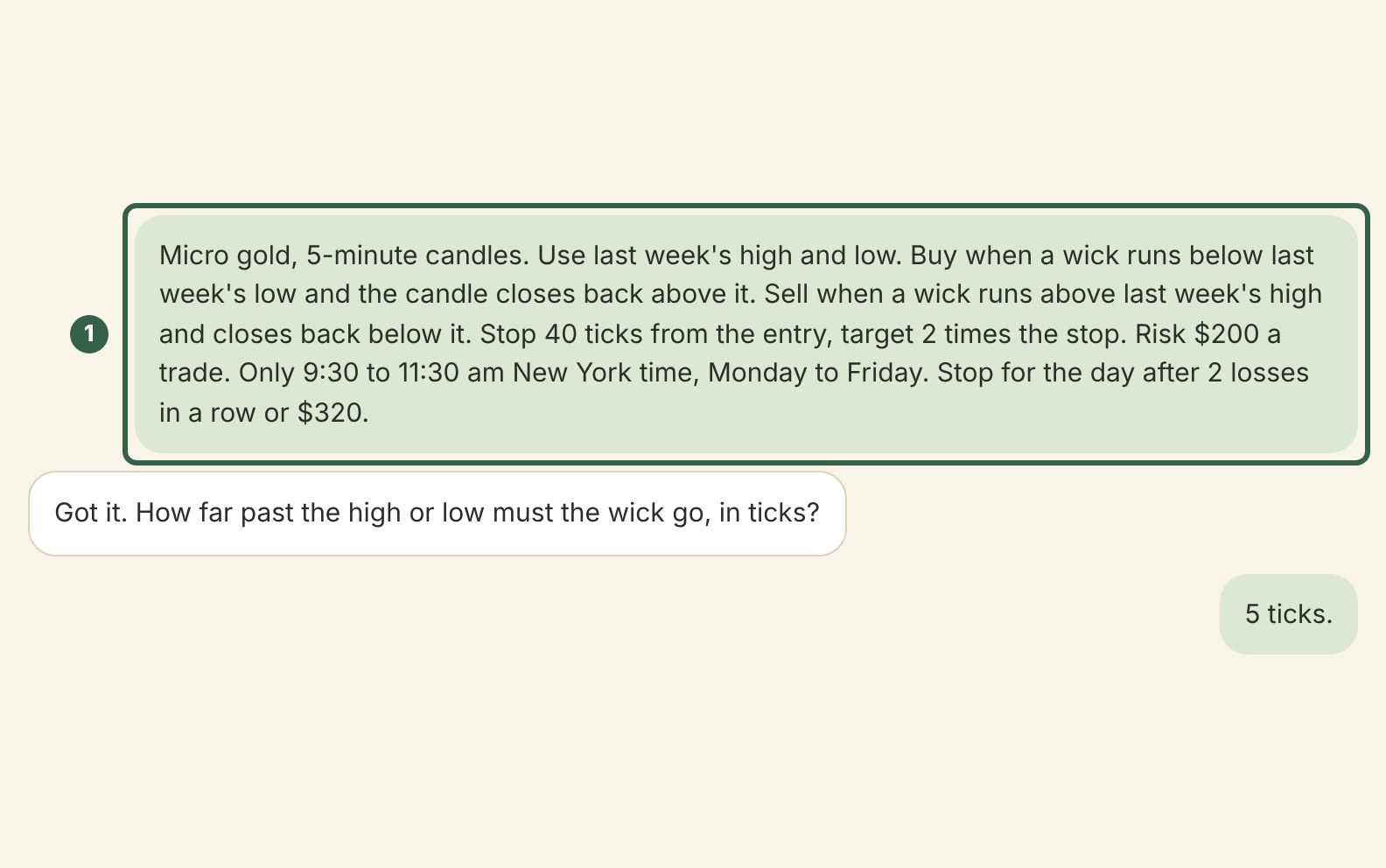
- Describe your trade at last week's or last month's levels in your own words: which levels, what price must do there, your stop, target, risk and hours. Answer every question, then press Check my rules.
- Read the levels back, and fill in lines 1, 2 and 4.
- Open your strategy in Strategies and press Change a rule. Press the Signal step and click into Which levels to use.
- Press Help me choose, pick three levels under Try a few, and press Run.
- Make the plain entry. On your strategy press Change a rule. On the Signal step press ⋯, then Change, and pick Signal at a clock time. Type 600 in Time of the signal, pick The way that candle closed, and press Save. Run it in Backtest on the Practice chart, and that's your line 5.
- Fill in lines 6 and 7. Take about $8 a trade off Try a few's profit for fees, and write the trade count beside it.
- Help article Describe your strategy in your own words
- Help article The signal at a level
- Help article The levels Signal at a level can read
- Help article Help me choose a setting
Quick check
1. Last week's levels won 2 of 2 trades. What's the careful reading?
2. Why did last month's levels give no trades?
3. Last week's 2 trades made $632 before fees. About what is that after fees?
0 of 3 answered.
Finished this lesson?
Tick it off and keep your place
Read the full notes
Last week's and last month's high and low are levels many traders watch. A sweep trades a wick past one that closes back. In Wildflower, open Strategies, press New strategy and describe it in your own words: last week's high and low, the sweep, and your stop, target, risk and hours. Wildflower builds it as Signal at a level. Press Check my rules, then Change a rule, open the Signal step, and try yesterday's, last week's and last month's levels in Which levels to use with Try a few on the free practice chart. Bigger levels are reached less often, so they trade rarely.
What you're building. These lessons share one goal: a setup card for every setup you trade: described in your own words in Wildflower, every number yours, one box tried three ways on the practice chart, and compared with a plain entry. Today you start a new card for last week's and last month's levels. Last lesson built the Holy Grail; next lesson trades an opening price.
| My setup card |
|---|
| 1. The setup: … (what price must do, and where) |
| 2. Its clock or its levels: … |
| 3. The box I test: …, tried at …, … and … |
| 4. Stop … ticks, target … times the stop, $… a trade, … to … New York |
| 5. A plain entry at 10:00 each day, same stop and target: … trades, $… after fees |
| 6. What the test showed: … trades, … won, $… after fees |
| 7. My pick, and why: … |
Why. Sam is made up, and so are his numbers. They're real runs of Wildflower's engine on the free practice chart's made-up prices. Sweeping last week's high and low traded twice in the whole test and won both. Last month's levels never traded. Two trades prove nothing. How these levels work: Why yesterday's high and low matter, which reads the same way for a week or a month.
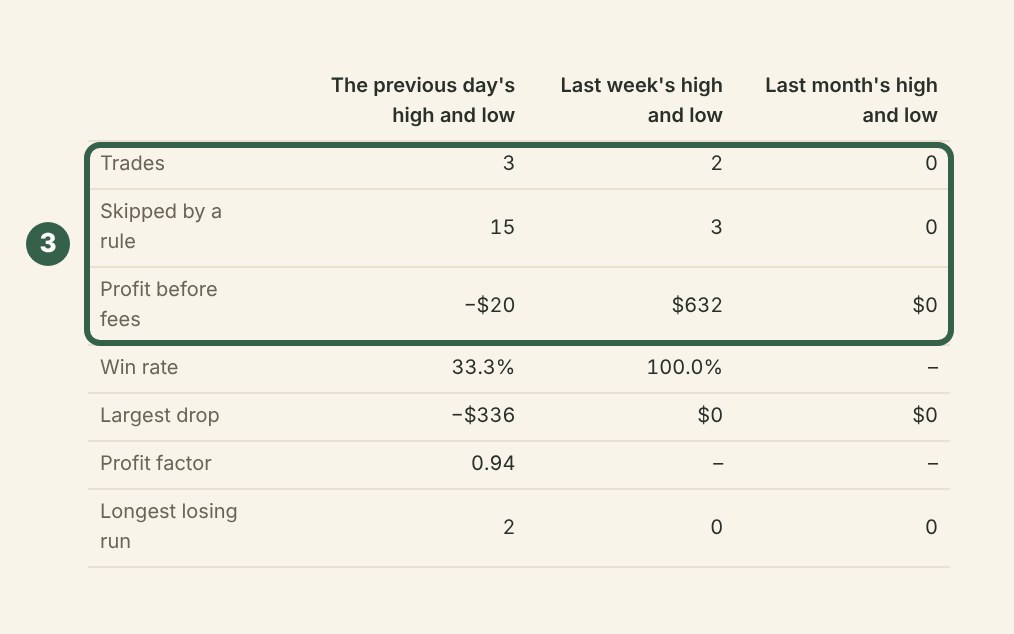
| Run | Trades | Won | Before fees | After fees | Largest drop |
|---|---|---|---|---|---|
| Plain 10:00 entry | 75 | 32 (42.7%) | +$736 | +$161.50 | −$1,652 |
| The previous day's high and low | 3 | 1 | −$20 | −$42.98 | −$336 |
| Last week's high and low | 2 | 2 | +$632 | +$616.68 | $0 |
| Last month's high and low | 0 | 0 | $0 | $0 | $0 |
The plain entry, and the trade count. The first row is the same strategy with its signal changed to Signal at a clock time: 10:00 New York each day, the way that 5-minute candle closed, same stop, target, risk and hours. Weekly and monthly levels are far apart, and Sam only trades 2 hours a day, so they were reached two times, or none. No line 7 can be written from that.
How traders trade weekly levels. We can't tell you which to choose. These are the common choices. A sweep, like Sam's. A target in the middle of the range or on its other side, with Target on the levels. Or longer trading hours, so price has time to reach levels this far apart.
Worked example
Made-up numbersSam's weekly levels card
Sam is made up. $20,000 account, micro gold at $1 a tick for each contract, $200 a trade with a 40-tick stop, 4 contracts.
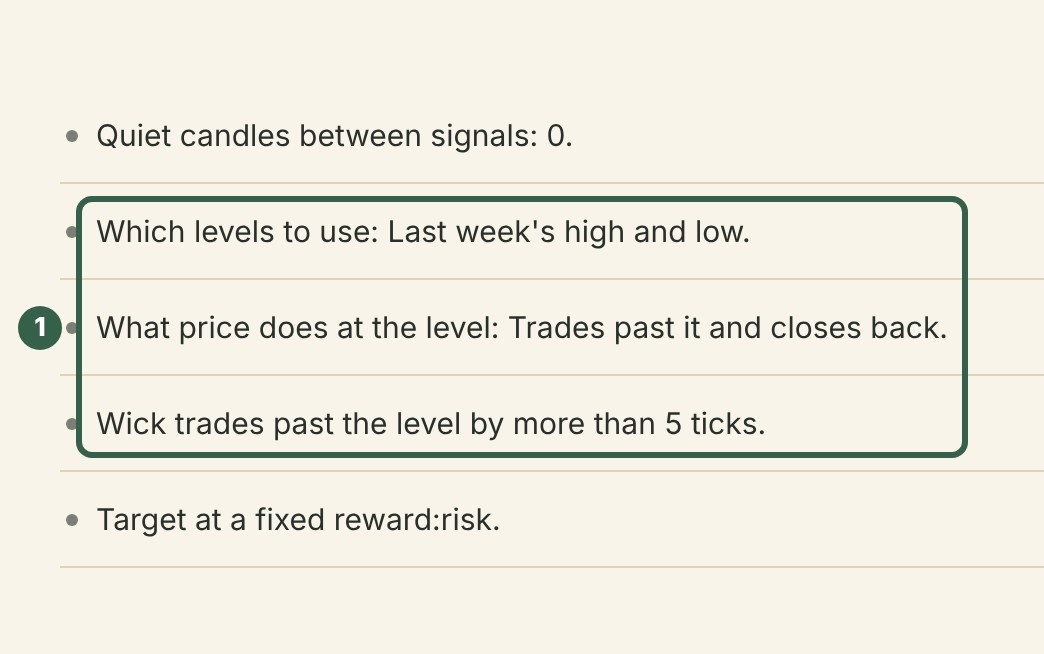
- Line 1: a wick more than 5 ticks past last week's high or low, closing back.
- Line 3: Which levels to use, tried as the previous day, last week and last month.
- Line 6: last week, 2 trades and 2 won. $632 before fees, minus about $8 × 2 = $15 in fees, is $617 after.
Line 7 is Sam's own pick. He writes that 2 trades can't be judged, and that he'd need longer hours to test it. Made-up prices, an example, not advice.
Trading is risky. You can lose money. This lesson shows how Wildflower works. It isn't advice.